











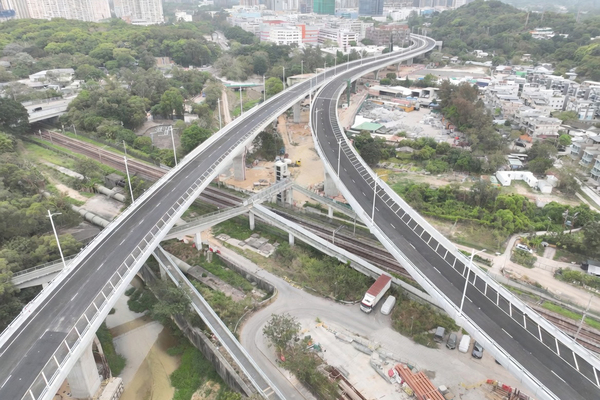
The Fanling Bypass (Eastern Section) will be commissioned at 8am on May 3.
With a total length of about 4 km, the bypass is the first major transport infrastructure project to be completed under the Northern Metropolis (NM) umbrella.
It supports the development of the NM, and specifically the Fanling North New Development Area (NDA), and enhances the connectivity of nearby villages.
The bypass is a dual two-lane carriageway, comprising at-grade roads, underpasses, and viaducts.
Starting at Fanling Highway near Kau Lung Hang in Tai Po, it passes through the On Lok Tsuen Industrial Area and the Lung Yeuk Tau Interchange, extends along the Ng Tung River, and connects to Shek Wu San Tsuen and the Fanling North NDA, serving as an important bypass linking North District in the New Territories with urban areas.
Upon commissioning, motorists will be able to travel between Fanling Lung Yeuk Tau, Luen Wo Hui, and Fanling Highway via the new route without passing through busy roads in the town centres of Sheung Shui and Fanling, thereby saving approximately 10 minutes of travel time during peak hours.
It will also divert future traffic from the Fanling North NDA, alleviate the amount of traffic on existing major roads in Fanling and Sheung Shui, and improve overall road conditions and operational efficiency in North District’s road network.
The Fanling Bypass (Eastern Section) is a large-scale project involving complex construction requirements. To enhance efficiency and address challenges, the project team adopted various innovative technologies.
China-made ultra-high strength S960 steel was used in the construction of a cycle track and pedestrian bridge at the Lung Yeuk Tau Interchange. It is the first footbridge in the world to use such steel, the strength of which is nearly three times that of conventional steel, significantly reducing steel consumption and the weight of the bridge.
In addition, the horizontal bridge rotation method was adopted in Hong Kong for the first time in construction of the section spanning the East Rail Line railway. This method significantly shortened construction time and reduced construction risks.