









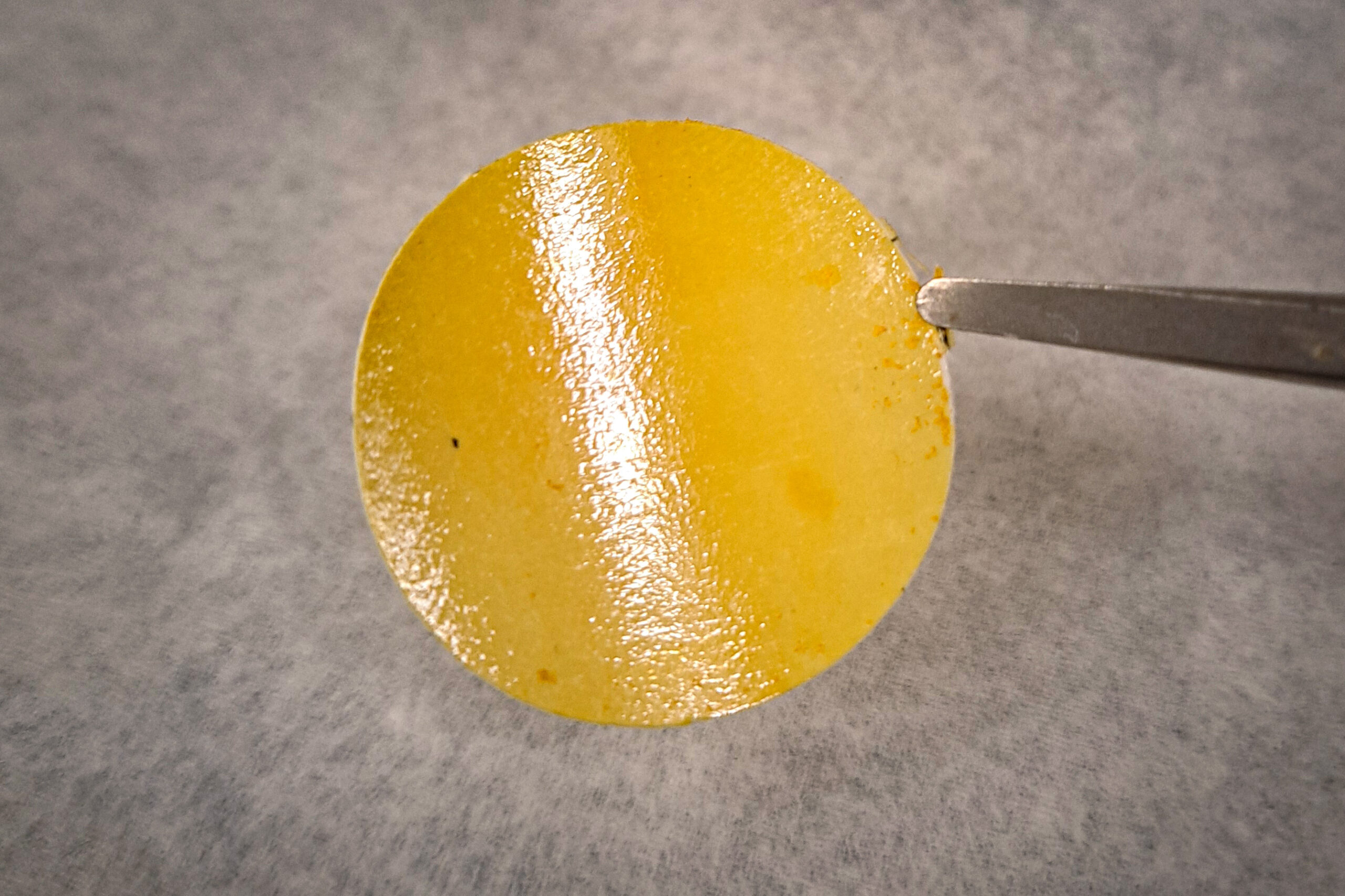
Separating crude oil into products such as gasoline, diesel, and heating oil is an energy-intensive process that accounts for about 6 percent of the world’s CO2 emissions. Most of that energy goes into the heat needed to separate the components by their boiling point.In an advance that could dramatically reduce the amount of energy needed for crude oil fractionation, MIT engineers have developed a membrane that filters the components of crude oil by their molecular size.“This is a whole new way of envisioning a separation process. Instead of boiling mixtures to purify them, why not separate components based on shape and size? The key innovation is that the filters we developed can separate very small molecules at an atomistic length scale,” says Zachary P. Smith, an associate professor of chemical engineering at MIT and the senior author of the new study.The new filtration membrane can efficiently separate heavy and light components from oil, and it is resistant to the swelling that tends to occur with other types of oil separation membranes. The membrane is a thin film that can be manufactured using a technique that is already widely used in industrial processes, potentially allowing it to be scaled up for widespread use.Taehoon Lee, a former MIT postdoc who is now an assistant professor at Sungkyunkwan University in South Korea, is the lead author of the paper, which appears today in Science.Oil fractionationConventional heat-driven processes for fractionating crude oil make up about 1 percent of global energy use, and it has been estimated that using membranes for crude oil separation could reduce the amount of energy needed by about 90 percent. For this to succeed, a separation membrane needs to allow hydrocarbons to pass through quickly, and to selectively filter compounds of different sizes.Until now, most efforts to develop a filtration membrane for hydrocarbons have focused on polymers of intrinsic microporosity (PIMs), including one known as PIM-1. Although this porous material allows the fast transport of hydrocarbons, it tends to excessively absorb some of the organic compounds as they pass through the membrane, leading the film to swell, which impairs its size-sieving ability.To come up with a better alternative, the MIT team decided to try modifying polymers that are used for reverse osmosis water desalination. Since their adoption in the 1970s, reverse osmosis membranes have reduced the energy consumption of desalination by about 90 percent — a remarkable industrial success story.The most commonly used membrane for water desalination is a polyamide that is manufactured using a method known as interfacial polymerization. During this process, a thin polymer film forms at the interface between water and an organic solvent such as hexane. Water and hexane do not normally mix, but at the interface between them, a small amount of the compounds dissolved in them can react with each other.In this case, a hydrophilic monomer called MPD, which is dissolved in water, reacts with a hydrophobic monomer called TMC, which is dissolved in hexane. The two monomers are joined together by a connection known as an amide bond, forming a polyamide thin film (named MPD-TMC) at the water-hexane interface.While highly effective for water desalination, MPD-TMC doesn’t have the right pore sizes and swelling resistance that would allow it to separate hydrocarbons.To adapt the material to separate the hydrocarbons found in crude oil, the researchers first modified the film by changing the bond that connects the monomers from an amide bond to an imine bond. This bond is more rigid and hydrophobic, which allows hydrocarbons to quickly move through the membrane without causing noticeable swelling of the film compared to the polyamide counterpart.“The polyimine material has porosity that forms at the interface, and because of the cross-linking chemistry that we have added in, you now have something that doesn’t swell,” Smith says. “You make it in the oil phase, react it at the water interface, and with the crosslinks, it’s now immobilized. And so those pores, even when they’re exposed to hydrocarbons, no longer swell like other materials.”The researchers also introduced a monomer called triptycene. This shape-persistent, molecularly selective molecule further helps the resultant polyimines to form pores that are the right size for hydrocarbons to fit through.This approach represents “an important step toward reducing industrial energy consumption,” says Andrew Livingston, a professor of chemical engineering at Queen Mary University of London, who was not involved in the study.“This work takes the workhorse technology of the membrane desalination industry, interfacial polymerization, and creates a new way to apply it to organic systems such as hydrocarbon feedstocks, which currently consume large chunks of global energy,” Livingston says. “The imaginative approach using an interfacial catalyst coupled to hydrophobic monomers leads to membranes with high permeance and excellent selectivity, and the work shows how these can be used in relevant separations.”Efficient separationWhen the researchers used the new membrane to filter a mixture of toluene and triisopropylbenzene (TIPB) as a benchmark for evaluating separation performance, it was able to achieve a concentration of toluene 20 times greater than its concentration in the original mixture. They also tested the membrane with an industrially relevant mixture consisting of naphtha, kerosene, and diesel, and found that it could efficiently separate the heavier and lighter compounds by their molecular size.If adapted for industrial use, a series of these filters could be used to generate a higher concentration of the desired products at each step, the researchers say.“You can imagine that with a membrane like this, you could have an initial stage that replaces a crude oil fractionation column. You could partition heavy and light molecules and then you could use different membranes in a cascade to purify complex mixtures to isolate the chemicals that you need,” Smith says.Interfacial polymerization is already widely used to create membranes for water desalination, and the researchers believe it should be possible to adapt those processes to mass produce the films they designed in this study.“The main advantage of interfacial polymerization is it’s already a well-established method to prepare membranes for water purification, so you can imagine just adopting these chemistries into existing scale of manufacturing lines,” Lee says.The research was funded, in part, by ExxonMobil through the MIT Energy Initiative.

- Trending
- Comments
- Latest








Stay ahead with the latest insights on Hong Kong’s economy, finance, and investments. From market trends to policy updates, we bring you in-depth analysis and expert opinions.
📩 Subscribe to our newsletter for exclusive updates.
📍 Follow us on social media for real-time news.
📧 Contact us: info@hongkong-invest.com