







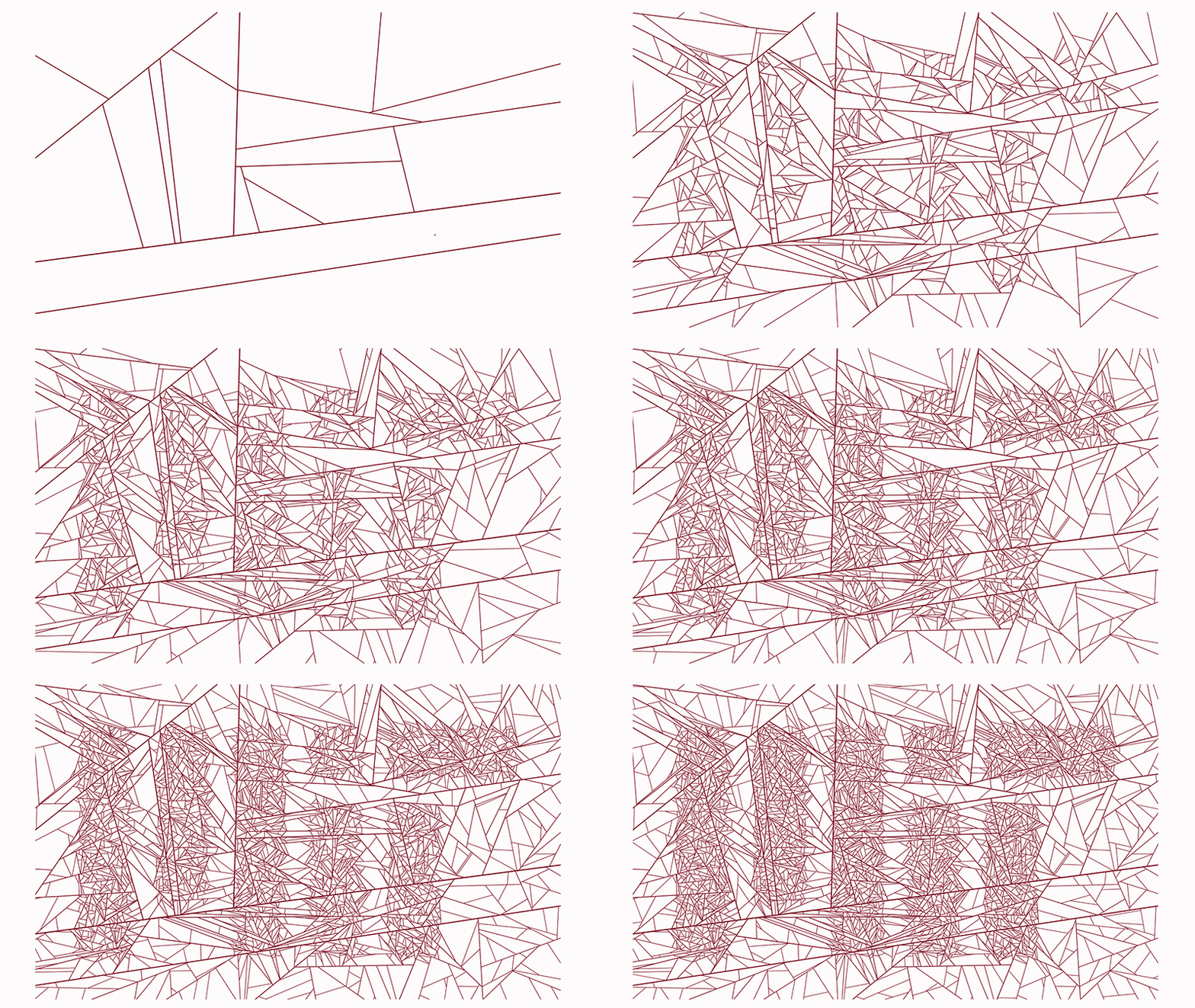
Order has long been the rule in the design of synthetic “metamaterials,” which have internal structures that give the whole material exceptional properties not found in nature.When scientists engineer a metamaterial, they design from a single building block, or “unit cell,” that is then copied and pasted many times over. The result is a precise, periodic microstructure that results in improved material performance. Now, a team from MIT and Northeastern University has found that engineering a little disorder into a material can further enhance its “meta” features. In an open-access study appearing today in the journal Nature, the researchers introduce a new way to design metamaterials, inspired by the types of networks that appear in a leaf’s vasculature, the veins in a dragonfly’s wings, and the virtual connections in a social network. These new metamaterials — termed “scale-rich metamaterials” — exhibit structures of varying sizes, which sprawl and connect to form a physical network.For decades, networks have been used as theoretical constructs to describe everything from cities to the internet to connections between neurons. The team has now applied such network designs to physical materials. They designed metamaterials made not from repeating unit cells, but from tiny support beams of varying sizes, similar to a network’s dense, web-like patterns. When subjected to physical tests, the new materials attained a widely controllable range of stiffness and held up against sudden impacts better than conventional, ordered metamaterials. They also were able to cushion and protect fragile objects embedded within the materials.The team designed their materials using an algorithm which generates an optimal network of microstructures for a desired material property. The procedure can be used to design resilient, impact-absorbing materials such as helmets and armor, as well as acoustic lenses — materials whose microstructure efficiently focuses sound or vibrations.“This is a completely new way of thinking for metamaterials,” says study author Carlos Portela, associate professor of mechanical engineering at MIT. “Unlocking this network design for materials really frees us to think of new microstructures and mechanical benefits that haven’t been possible before.” The study’s MIT co-authors include Andrew Yen-Jong Chen, Mohammad Charara, and Jayna Wadhwa, along with Csaba Both, Ting-Ting Gao, and Albert-László Barabási of Northeastern University, and Niek Mooij of Utrecht University in the Netherlands.Looking beyond orderNetwork science is a field of research that studies complex networks, the nodes and connections within a network, and how these elements relate to each other and to the network as a whole. Network science has been used to map and characterize a wide range of systems, from networks in nature, such as food webs, evolutionary trees, and neural connections, to financial markets, cellular and social networks, and the internet. Albert-László Barabási, a co-author of the new study, has been at the forefront of network science. A professor of physics at Northeastern University, Barabási explores the structure of complex networks across many disciplines, studying where a network may exhibit vulnerabilities and how it could be made more robust.Most of Barabási’s work has involved conceptual networks, or networks that are mapped onto existing systems. Recently, he wondered: Could network science be applied to build a physical material with certain desired properties that are not possible in nature? For this, Barabási joined efforts with Portela, whose group at MIT specializes in metamaterials. The researchers engineer materials from the ground up, with precisely patterned microstructures that enhance the material’s performance overall. Like others in the field, Portela has built metamaterials from a single unit cell, repeating this building block in patterns such as square lattice structures and honeycomb architectures.In many cases, Portela has found that such ordered patterns do improve a material’s strength and resilience. But if these materials are punctured or cracked, the rest quickly buckles and fails. He says that’s because the internal structure is all the same; if one region of the material is deformed, the surrounding, similar unit cells will respond and deform in kind.“We’ve spent years looking at periodic and ordered microstructures, and we’ve learned there are a lot of limitations and non-ideal responses, such as this localization effect,” Portela says. “We wanted to break free of that notion and use network science to design these materials.”Line by lineThe team developed an algorithm to virtually generate a network of beams with the constraints of a physical material. When applying network science to something like the internet, researchers haven’t had to consider physical constraints, such as limiting the number, density, or intersection of connections. In a physical material, the number and thickness of beams, and the space between them, start to matter. To design a physical network, the team’s algorithm starts by drawing a point at a random coordinate in a domain representing the size of the final material. The program draws a line at a random angle, which stretches through the point and crosses the entire space. The program then repeats the process with a second point, at a second random coordinate, and a line drawn through the point at another random angle, until that second line reaches a boundary, of either the whole domain, or the first drawn line. The process then repeats, again and again, drawing progressively shorter, thinner lines. The resulting material represents a dense network of intersecting beams of many varying sizes. Scientists can vary the type of network that the program generates, by varying the thickness of the starting line and how fast that thickness decreases with each successive line drawn. By simply tuning these two parameters, the team found they could generate a huge range of networks. They then carried out simulations to predict how tuning one or the other, or both, by varying degrees, would change a material’s stiffness and other physical properties. “We see we can really tune the stiffness of a material just by changing these two parameters, which dictate how these network patterns get generated,” Portela says. The team then fabricated physical materials with microstructures that were patterned after the networks they virtually generated. They used 3D-printing methods to deposit polymer into patterns of tiny, interconnecting beams. Each resulting sample was a large square, about the size of a credit card, with internal beams that ranged from microns to centimeters in scale. They put the samples through various physical tests, such as dropping a large weight onto them and squeezing them with increasing force. They recorded the materials’ response, along with samples of conventional lattice and honeycomb metamaterials. The network-inspired samples, they found, were more resilient to compression and impacts. “Because there is such a richness of length scales in these networked materials, if one part fails, there is a strong web of structures around it that keeps the entire material from failing catastrophically,” Portela says. “It’s more efficient at distributing damage and absorbing energy.”As another demonstration, the researchers designed a material inspired by the density-graded microstructure of a pomelo’s thick rind. They designed the material with edges made from a denser network of beams, and showed it could cushion and protect a fragile object that was embedded at the center of the network.“This work provides a design framework for materials whose features vary over a very wide range,” says materials expert Tian “Tim” Chen, associate professor in the Department of Aeronautics at Imperial College London, who was not involved with the study. “That may lead to a next generation of materials with unprecedented physical behavior, for any structure that must carry load, absorb energy or control vibration.”This work was supported, in part, by the U.S. National Science Foundation’s Designing Materials to Revolutionize and Engineer our Future (DMREF) program.

Inspired by networks found in nature, engineers design stronger, more resilient “metamaterials”

- Trending
- Comments
- Latest






Stay ahead with the latest insights on Hong Kong’s economy, finance, and investments. From market trends to policy updates, we bring you in-depth analysis and expert opinions.
📩 Subscribe to our newsletter for exclusive updates.
📍 Follow us on social media for real-time news.
📧 Contact us: info@hongkong-invest.com