








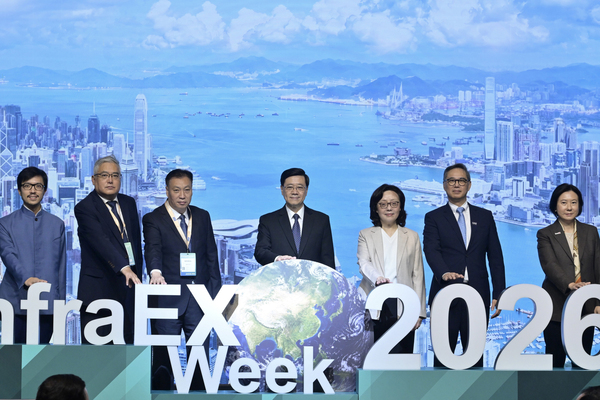

InfraEX Week 2026, spearheaded by the Development Bureau, opened today.
The event aims to establish a premier international exchange platform to promote sustainable development, enhance infrastructure delivery efficiency and accelerate the adoption of innovative technologies. It serves as a key catalyst to modernise and transform the construction industry.
Speaking at the grand opening ceremony, Chief Executive John Lee said that in a world shaped by shifting geopolitics, urgent climate challenges and rapid technological advance, ideas must be turned into lasting projects through innovation, collaboration and clear strategic direction.
He added that Hong Kong’s First Five-Year Plan provides a vital roadmap for the future, giving businesses, investors and innovators clear insight into the city’s development and emerging opportunities. He cited the Northern Metropolis, which is central to the Plan, as a prime example of these opportunities.
To build the Northern Metropolis and all that it promises, Mr Lee said Hong Kong must deliver future-ready infrastructure supported by smart city concepts, artificial intelligence, advanced engineering technologies and innovative construction methods and materials. He stressed that collaboration is the most crucial factor for achieving excellence in the construction industry.
Mr Lee then witnessed the exchange of a letter of intent and memoranda of understanding between the Development Bureau and various local and overseas institutions. These agreements will foster deeper cross-regional and cross-sectoral collaboration, laying a solid foundation for more local and Mainland construction enterprises and products to go global.
Vice Minister of the Ministry of Water Resources Liu Dongshun noted at the ceremony that the Hong Kong Special Administrative Region Government announced its First Five-Year Plan in September this year, outlining goals to advance the Guangdong-Hong Kong-Macao Greater Bay Area (GBA), strengthen physical infrastructure connectivity and boost digitalisation and infrastructure resilience. He added that Hong Kong is leveraging its unique advantage of strong national support alongside close global connections to reinforce its position as an international infrastructure hub.
He stressed that the Ministry of Water Resources will deepen exchanges and co-operation with Hong Kong on water-related affairs, providing reliable water security to support the GBA’s high-quality development and safeguard the city’s long-term prosperity and stability.
The Week features three major construction events: its flagship opening event, the 2nd International Infrastructure & Projects Leaders Summit, alongside the International Conference on Modular Construction 2026 and the Construction Innovation Expo 2026.
Held concurrently today, the 2nd International Infrastructure & Projects Leaders Summit is themed “Envisioning a Sustainable Future: From Insights to Impacts”. It explored strategies to tackle industry challenges while driving the sector’s modernisation and high-quality growth.
In her welcome remarks at the Summit luncheon, Secretary for Development Bernadette Linn said that under “one country, two systems”, Hong Kong proactively integrates into and serves national development. She added that the city remains committed to its role as a “super-connector” and “super value-adder” to help internationalise national standards and showcase the nation’s innovation and technology to the world.
She noted that the Government is steering the construction industry towards advanced, intelligent and high-quality growth. While accelerating the Northern Metropolis development, the Government is overhauling practices across the board, harnessing artificial intelligence and promoting the widespread adoption of advanced construction materials and technologies.
Permanent Secretary for Development (Works) Ricky Lau said in his keynote presentation at the Summit that the Government is accelerating the Northern Metropolis and other major infrastructure projects, creating vast opportunities for the construction industry.
He noted that as the industry navigates rapid technological shifts, infrastructure upgrades and climate resilience, it is transitioning from traditional delivery models towards a more industrialised, digitalised and tech-enabled phase. This transformation will be driven by three core pillars – innovation, talent development and collaboration – enabling the industry to move forward.
Over 800 major infrastructure project leaders and experts from more than 30 countries and regions attended the Summit, including senior Mainland and overseas government officials as well as representatives from renowned organisations such as the International Institute for Management Development. They shared the latest infrastructure initiatives and challenges at the presentation session and four plenary sessions.