









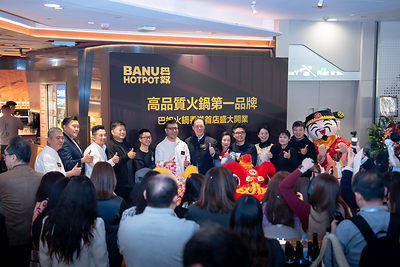
HONG KONG, Nov. 24, 2026 /PRNewswire/ — Banu Hotpot (Banu), a premium hotpot brand from mainland China, officially opened its first Hong Kong restaurant on the 14th floor of Hysan Place in Causeway Bay. Crowds of local diners queued outside the restaurant on opening day. Banu Classic Beef Tripe and Wild Mushroom Soup Base were ordered at almost every table, while Hong Kong exclusives including A4 Japanese Wagyu and a selection of local chilled seafood also proved popular.
Guests included King Leung, Associate Director-General of Investment Promotion at Invest Hong Kong (InvestHK), Sindy Wong, Head of Consumer and Hospitality at InvestHK, Ms. CHAN Fung Ha, Rebecca, Senior Vice President, Consumer and Hospitality at InvestHK, and Mr Tong Ng, Founding and Executive Chairman of the Hong Kong Mainland Catering Association. Representatives from government bodies, industry associations and business partners also attended to congratulate Banu.

Ceremony for the Grand Opening of Banu’s First Hong Kong Restaurant
In his remarks, Frank Chen, Banu’s Hong Kong regional head, said many local diners had previously made special trips to Banu’s Shenzhen restaurants. Their support reinforced Banu’s decision to open in Hong Kong. He said he hoped Banu would become a favourite among Hong Kong diners.
King Leung also spoke at the ceremony. He noted that Hong Kong is an international culinary capital where diners expect high standards. Banu’s focus on quality ingredients, he said, meets the needs of the local market. He added that InvestHK would fully support Banu in using Hong Kong as a base to showcase the quality of Chinese hotpot and the confidence behind its culinary tradition to an international audience.
Banu founder Du Zhongbing brought the ceremony to a high point with his remarks. He thanked InvestHK, diners, business partners and the Banu team for helping bring the first Hong Kong restaurant to fruition. Du said Banu had expanded to more than 60 cities across mainland China and opened nearly 250 directly operated restaurants in the 25 years since its founding. Throughout that time, Banu has stayed true to its commitment to bringing out the natural flavours of its ingredients and giving diners a premium hotpot experience.
Banu’s “King and Queen” Lead the Debut of The 12 Signature Classics
Banu’s signature “King and Queen” pairing quickly became a talking point among Hong Kong diners on opening day. The crisp Banu Classic Beef Tripe is the “King”, and the umami-rich Wild Mushroom Soup Base is the “Queen”. Many diners came specifically to try the two, which were among the most frequently ordered items on the first day.
Beef tripe is high in protein, low in fat and rich in trace minerals such as iron, zinc and selenium. To preserve its natural nutrients and crisp, tender texture, Banu worked with Professor Hongjun Li of Southwest University to introduce papain-based tenderisation in place of the caustic soda process commonly used in the industry. The technique preserves the tripe’s springy texture and natural qualities. For Hand-Torn New Zealand Beef Tripe, staff bring large, intact pieces to the table and tear them by hand. The tripe has a fresh, crisp bite.
The signature Wild Mushroom Soup Base is made with wild mushrooms sourced from their natural habitat at elevations above 3,000 metres on the Yunnan–Guizhou Plateau. It is freshly simmered in the restaurant every day and served within a strict four-hour window for the best flavour, preserving its natural aroma and umami.
Alongside the two signature items, The 12 Signature Classics showcase regional ingredients sourced directly from producers across China, with quality checks at the source. Banu spent nearly three years working with farmers to refine the growing standards for its Henan Naturally Grown Spinach. The spinach is harvested only after Frost’s Descent, the autumn solar term, when it has developed a fuller, sweeter flavour. Banu sources its Inner Mongolian Grass-Fed Lamb directly from the Ujimqin grasslands, selecting free-ranging lambs raised for around 180 days. The meat is tender, with a rich aroma from its fat.
Seasonality also guides Banu’s ingredient selection. The restaurant offers a fresh selection of seasonal vegetables each month. By sourcing bamboo shoots from different growing regions with staggered harvests, Banu can serve them fresh 365 days a year. The seasonal changes give Hong Kong diners a varied menu and the chance to try ingredients at their best.
Hong Kong Diners Favour Exclusive Wagyu and Chilled Seafood
Banu selected a range of Hong Kong-exclusive dishes for its first restaurant in the city, and diners have praised them since opening. The meat selection features premium cuts sourced from around the world, including A4 Japanese Wagyu and USDA Prime Boneless Short Ribs. The A4-grade marbled Wagyu has a delicate texture, a creamy, buttery aroma and a rich beef flavour. Du previously pledged that the Hong Kong restaurant would uphold the same quality standards as Banu’s mainland restaurants, serving only whole-muscle cuts and using no reconstituted or otherwise pre-prepared meat products.
The restaurant also offers a selection of chilled seafood, prioritising quality suppliers in Hong Kong. The menu includes Chilled Abalone, Chilled Black Tiger Prawn, Chilled Garoupa, Chilled White Clam and Chilled Squid, allowing diners to enjoy Banu’s signature ingredients from the mountains of mainland China alongside the delicate sweetness of local seafood in the same hotpot.
Banu and Ronald Shao (Shao Tak-lung), the renowned chef featured on the culinary competition programme Chef of China, co-developed Shao’s Seafood Soup Base exclusively for Hong Kong. Fresh prawns and dried scallops are slowly simmered to give the broth a rich, naturally sweet flavour. Developed for local tastes, the soup base is especially well suited to cooking seafood at the table.
Banu’s Third-Generation Supply Chain Keeps Ingredients Fresh
Keeping ingredients fresh is a race against time. Banu pioneered the industry’s third-generation supply chain around three principles. They are “Chilled fresh whenever possible, never frozen”, “Natural whenever possible, free of artificial additives” and “Prepared fresh daily whenever possible, never kept overnight”. Centralised processing, cold-chain transport throughout and daily deliveries help Banu apply the same high standards to every ingredient.
Banu built its own Chongqing Soup Base Production Facility and operates five full-service central kitchens across mainland China. Its supply network covers more than 60 cities and supports daily deliveries of fresh ingredients to its restaurants nationwide.
The Hong Kong restaurant relies on the same third-generation supply chain. Its regional central kitchens coordinate daily deliveries under continuous refrigeration, keeping the restaurant stocked with fresh ingredients and helping Banu deliver the same quality in Hong Kong as in mainland China. This system helps preserve the natural flavours of the ingredients served at the new restaurant.
Banu has long regarded Hong Kong as an important market for its development. Du said Banu wants “to bring Hong Kong diners premium hotpot that showcases the rich variety of ingredients found across more than 9.6 million square kilometres of mainland China”. Banu will continue to build its presence in Hong Kong step by step, with close attention to the quality of its food and service.
About Banu Hotpot
Founded in 2001, Banu pioneered the beef tripe hotpot category. According to Frost & Sullivan, it was the largest brand in China’s premium hotpot market by revenue in 2025.
Banu’s approach to food is built around bringing out the natural flavours of its ingredients. The brand uses fresh chilled ingredients in place of frozen ones, favours natural ingredients without additives and prepares ingredients for same-day use wherever possible. Banu pioneered the industry’s third-generation supply chain, with central kitchens supplying restaurants directly through daily deliveries nationwide.
In its second year, Banu moved away from the caustic soda process common in the industry. Working with Professor Hongjun Li of Southwest University, it pioneered the use of natural papain to tenderise beef tripe, giving it a crisper, more tender texture and advancing the way tripe is processed.
Banu operates nearly 250 directly operated restaurants across more than 60 cities, including Beijing, Shanghai, Zhengzhou, Shenzhen, Xi’an, Hangzhou, Nanjing, Wuhan and Hefei. It has appeared on Dazhong Dianping’s Must-Eat List for eight years in total, including multiple consecutive years.
In July 2021, Banu opened its first Shenzhen restaurant at One Avenue, marking its entry into southern China following its expansion in northern and eastern China.
On 13 October 2026, Banu held a press conference in Causeway Bay to announce its first Hong Kong restaurant, including the opening arrangements, its plans for the Hong Kong market, and its future development plans.