








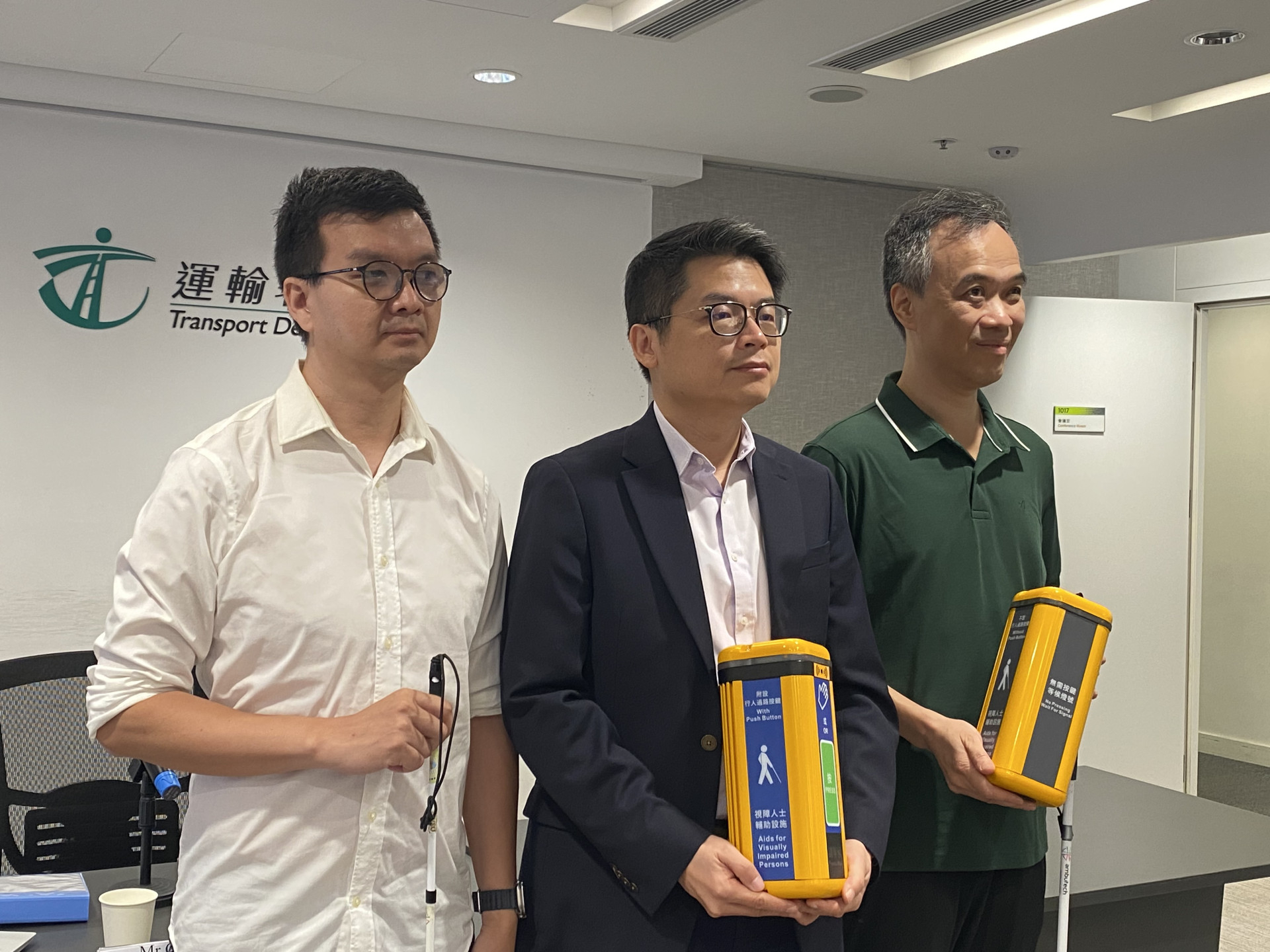
The department launched a pilot scheme in 2021, which saw new units put in place at more than 20 crossings across the city to test their performance.
It said 13,000 replacements are needed due to most of the existing units having been in use for more than 20 years, which far exceeds their expected lifespan of 10 years.
“Some of the electronic audible traffic signal units’ fault rates are on the rise, causing higher maintenance costs,” the department’s chief engineer, Gordon Kwok, said.
“So we would like to replace them and at the same time include some new functions that are more adaptable to users.”
Kwok said new features have been incorporated into the system, such as tactile maps to provide layout information on the crossing and voice messages that read out the names of the streets near the crossing in Cantonese, Putonghua and English.
Karl Lee, who is visually impaired, said the messages allow him to easily gauge where he is, rather than having to memorise the streets and counting them off when walking.
“For example, if I’m walking up from Nam Cheong Street, I’ll have to count off the streets I have crossed, including Yu Chau Street, Apliu Street, Cheung Sha Wan Road,” he said.
“Sometimes I might make mistakes, and I’ll have to ask people where I am.
“Having the new machines can help me easily find out which street I’m currently at.”
Kwok said a total of 15,000 dedicated wireless devices will be distributed via the Society of the Blind to enable the visually impaired to use the remote control in them to increase the volume of the electronic audible traffic signal units when needed.
The department has installed the new electronic audible traffic signal units at 27 crossings so far. All renewals are expected to be completed by the end of 2027.