









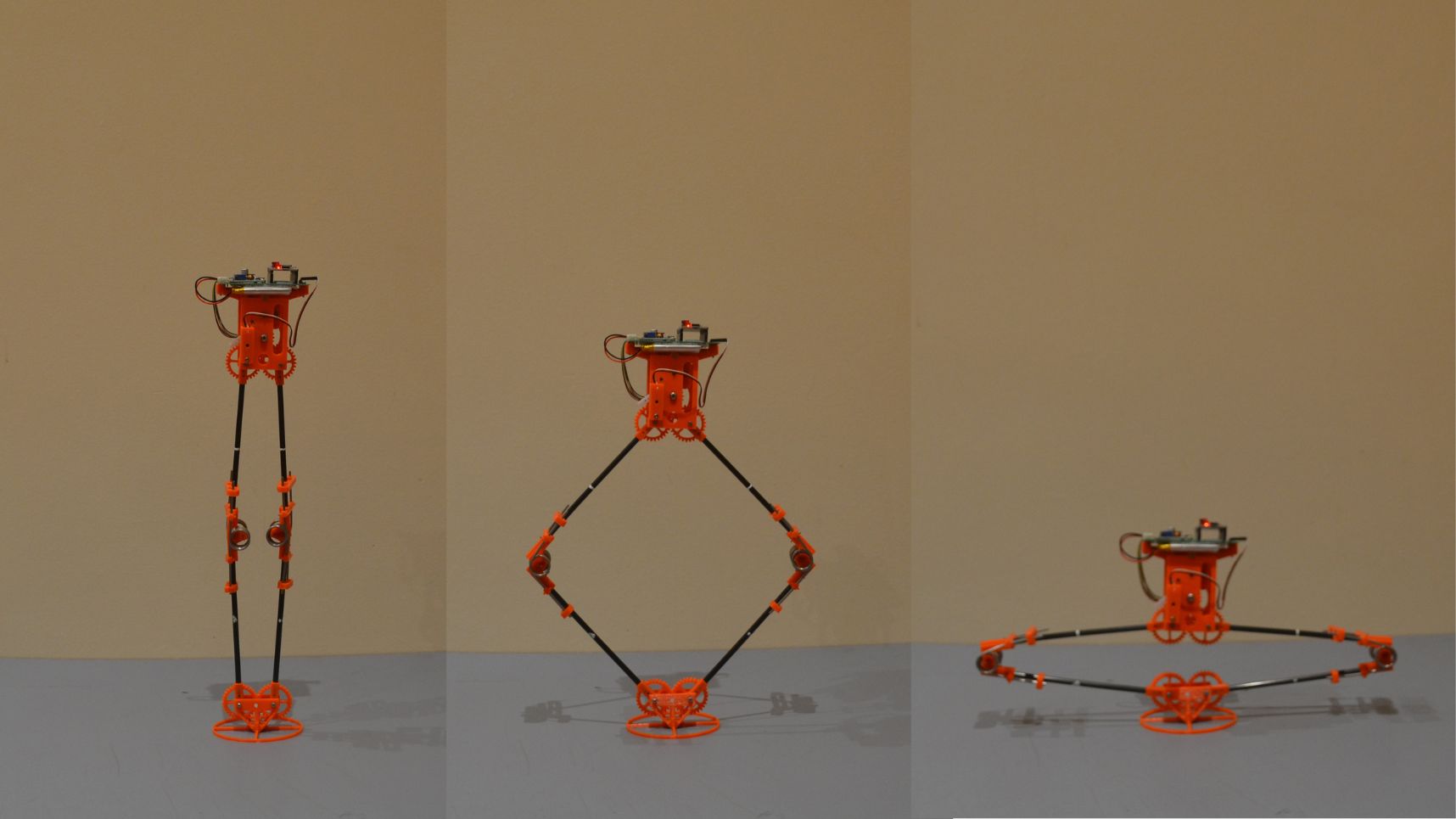
Diffusion models like OpenAI’s DALL-E are becoming increasingly useful in helping brainstorm new designs. Humans can prompt these systems to generate an image, create a video, or refine a blueprint, and come back with ideas they hadn’t considered before.But did you know that generative artificial intelligence (GenAI) models are also making headway in creating working robots? Recent diffusion-based approaches have generated structures and the systems that control them from scratch. With or without a user’s input, these models can make new designs and then evaluate them in simulation before they’re fabricated.A new approach from MIT’s Computer Science and Artificial Intelligence Laboratory (CSAIL) applies this generative know-how toward improving humans’ robotic designs. Users can draft a 3D model of a robot and specify which parts they’d like to see a diffusion model modify, providing its dimensions beforehand. GenAI then brainstorms the optimal shape for these areas and tests its ideas in simulation. When the system finds the right design, you can save and then fabricate a working, real-world robot with a 3D printer, without requiring additional tweaks.The researchers used this approach to create a robot that leaps up an average of roughly 2 feet, or 41 percent higher than a similar machine they created on their own. The machines are nearly identical in appearance: They’re both made of a type of plastic called polylactic acid, and while they initially appear flat, they spring up into a diamond shape when a motor pulls on the cord attached to them. So what exactly did AI do differently?A closer look reveals that the AI-generated linkages are curved, and resemble thick drumsticks (the musical instrument drummers use), whereas the standard robot’s connecting parts are straight and rectangular.Better and better blobsThe researchers began to refine their jumping robot by sampling 500 potential designs using an initial embedding vector — a numerical representation that captures high-level features to guide the designs generated by the AI model. From these, they selected the top 12 options based on performance in simulation and used them to optimize the embedding vector.This process was repeated five times, progressively guiding the AI model to generate better designs. The resulting design resembled a blob, so the researchers prompted their system to scale the draft to fit their 3D model. They then fabricated the shape, finding that it indeed improved the robot’s jumping abilities.The advantage of using diffusion models for this task, according to co-lead author and CSAIL postdoc Byungchul Kim, is that they can find unconventional solutions to refine robots.“We wanted to make our machine jump higher, so we figured we could just make the links connecting its parts as thin as possible to make them light,” says Kim. “However, such a thin structure can easily break if we just use 3D printed material. Our diffusion model came up with a better idea by suggesting a unique shape that allowed the robot to store more energy before it jumped, without making the links too thin. This creativity helped us learn about the machine’s underlying physics.”The team then tasked their system with drafting an optimized foot to ensure it landed safely. They repeated the optimization process, eventually choosing the best-performing design to attach to the bottom of their machine. Kim and his colleagues found that their AI-designed machine fell far less often than its baseline, to the tune of an 84 percent improvement.The diffusion model’s ability to upgrade a robot’s jumping and landing skills suggests it could be useful in enhancing how other machines are designed. For example, a company working on manufacturing or household robots could use a similar approach to improve their prototypes, saving engineers time normally reserved for iterating on those changes.The balance behind the bounceTo create a robot that could jump high and land stably, the researchers recognized that they needed to strike a balance between both goals. They represented both jumping height and landing success rate as numerical data, and then trained their system to find a sweet spot between both embedding vectors that could help build an optimal 3D structure.The researchers note that while this AI-assisted robot outperformed its human-designed counterpart, it could soon reach even greater new heights. This iteration involved using materials that were compatible with a 3D printer, but future versions would jump even higher with lighter materials.Co-lead author and MIT CSAIL PhD student Tsun-Hsuan “Johnson” Wang says the project is a jumping-off point for new robotics designs that generative AI could help with.“We want to branch out to more flexible goals,” says Wang. “Imagine using natural language to guide a diffusion model to draft a robot that can pick up a mug, or operate an electric drill.”Kim says that a diffusion model could also help to generate articulation and ideate on how parts connect, potentially improving how high the robot would jump. The team is also exploring the possibility of adding more motors to control which direction the machine jumps and perhaps improve its landing stability.The researchers’ work was supported, in part, by the National Science Foundation’s Emerging Frontiers in Research and Innovation program, the Singapore-MIT Alliance for Research and Technology’s Mens, Manus and Machina program, and the Gwangju Institute of Science and Technology (GIST)-CSAIL Collaboration. They presented their work at the 2025 International Conference on Robotics and Automation.

- Trending
- Comments
- Latest








Stay ahead with the latest insights on Hong Kong’s economy, finance, and investments. From market trends to policy updates, we bring you in-depth analysis and expert opinions.
📩 Subscribe to our newsletter for exclusive updates.
📍 Follow us on social media for real-time news.
📧 Contact us: info@hongkong-invest.com