









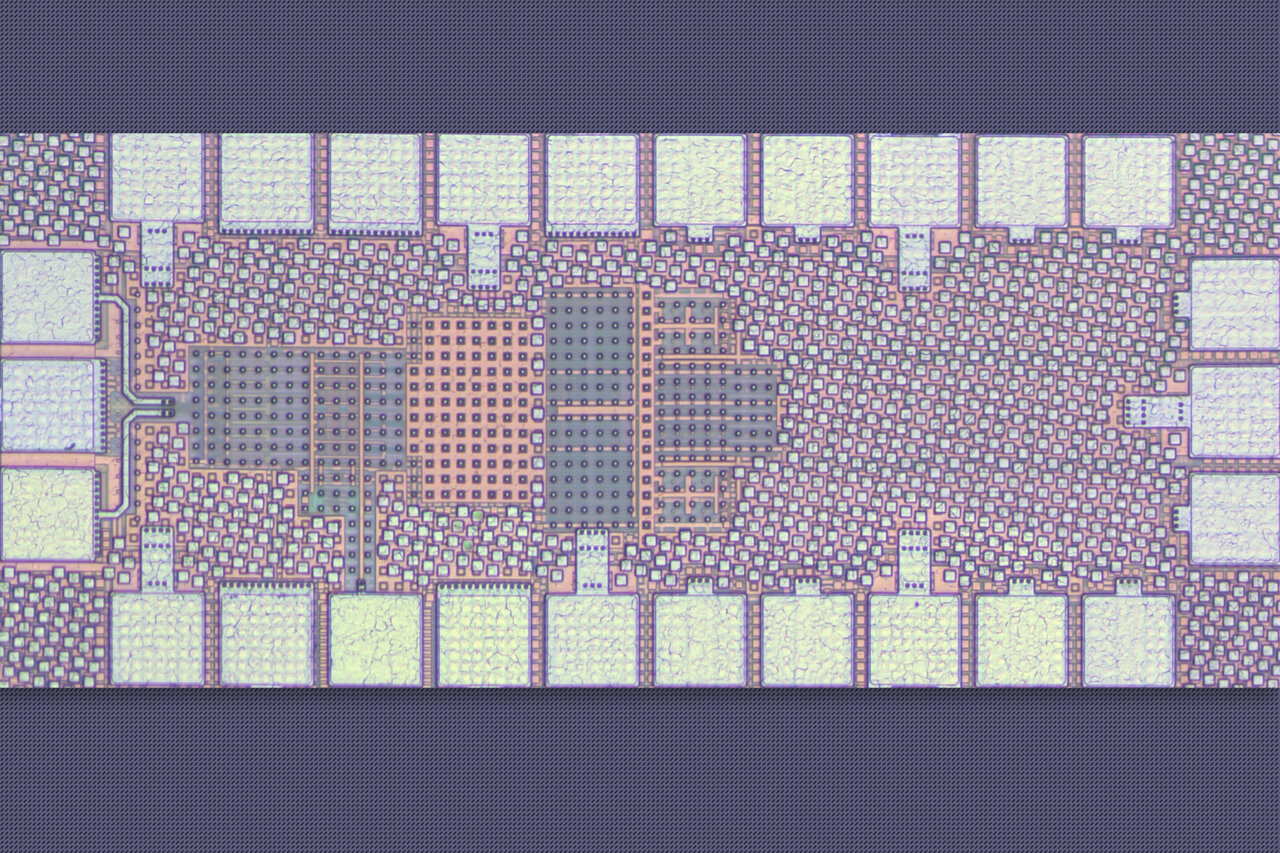
MIT researchers have designed a compact, low-power receiver for 5G-compatible smart devices that is about 30 times more resilient to a certain type of interference than some traditional wireless receivers.The low-cost receiver would be ideal for battery-powered internet of things (IoT) devices like environmental sensors, smart thermostats, or other devices that need to run continuously for a long time, such as health wearables, smart cameras, or industrial monitoring sensors.The researchers’ chip uses a passive filtering mechanism that consumes less than a milliwatt of static power while protecting both the input and output of the receiver’s amplifier from unwanted wireless signals that could jam the device.Key to the new approach is a novel arrangement of precharged, stacked capacitors, which are connected by a network of tiny switches. These miniscule switches need much less power to be turned on and off than those typically used in IoT receivers.The receiver’s capacitor network and amplifier are carefully arranged to leverage a phenomenon in amplification that allows the chip to use much smaller capacitors than would typically be necessary. “This receiver could help expand the capabilities of IoT gadgets. Smart devices like health monitors or industrial sensors could become smaller and have longer battery lives. They would also be more reliable in crowded radio environments, such as factory floors or smart city networks,” says Soroush Araei, an electrical engineering and computer science (EECS) graduate student at MIT and lead author of a paper on the receiver.He is joined on the paper by Mohammad Barzgari, a postdoc in the MIT Research Laboratory of Electronics (RLE); Haibo Yang, an EECS graduate student; and senior author Negar Reiskarimian, the X-Window Consortium Career Development Assistant Professor in EECS at MIT and a member of the Microsystems Technology Laboratories and RLE. The research was recently presented at the IEEE Radio Frequency Integrated Circuits Symposium.A new standardA receiver acts as the intermediary between an IoT device and its environment. Its job is to detect and amplify a wireless signal, filter out any interference, and then convert it into digital data for processing.Traditionally, IoT receivers operate on fixed frequencies and suppress interference using a single narrow-band filter, which is simple and inexpensive.But the new technical specifications of the 5G mobile network enable reduced-capability devices that are more affordable and energy-efficient. This opens a range of IoT applications to the faster data speeds and increased network capability of 5G. These next-generation IoT devices need receivers that can tune across a wide range of frequencies while still being cost-effective and low-power.“This is extremely challenging because now we need to not only think about the power and cost of the receiver, but also flexibility to address numerous interferers that exist in the environment,” Araei says.To reduce the size, cost, and power consumption of an IoT device, engineers can’t rely on the bulky, off-chip filters that are typically used in devices that operate on a wide frequency range.One solution is to use a network of on-chip capacitors that can filter out unwanted signals. But these capacitor networks are prone to special type of signal noise known as harmonic interference.In prior work, the MIT researchers developed a novel switch-capacitor network that targets these harmonic signals as early as possible in the receiver chain, filtering out unwanted signals before they are amplified and converted into digital bits for processing.Shrinking the circuitHere, they extended that approach by using the novel switch-capacitor network as the feedback path in an amplifier with negative gain. This configuration leverages the Miller effect, a phenomenon that enables small capacitors to behave like much larger ones.“This trick lets us meet the filtering requirement for narrow-band IoT without physically large components, which drastically shrinks the size of the circuit,” Araei says.Their receiver has an active area of less than 0.05 square millimeters.One challenge the researchers had to overcome was determining how to apply enough voltage to drive the switches while keeping the overall power supply of the chip at only 0.6 volts.In the presence of interfering signals, such tiny switches can turn on and off in error, especially if the voltage required for switching is extremely low.To address this, the researchers came up with a novel solution, using a special circuit technique called bootstrap clocking. This method boosts the control voltage just enough to ensure the switches operate reliably while using less power and fewer components than traditional clock boosting methods.Taken together, these innovations enable the new receiver to consume less than a milliwatt of power while blocking about 30 times more harmonic interference than traditional IoT receivers.“Our chip also is very quiet, in terms of not polluting the airwaves. This comes from the fact that our switches are very small, so the amount of signal that can leak out of the antenna is also very small,” Araei adds.Because their receiver is smaller than traditional devices and relies on switches and precharged capacitors instead of more complex electronics, it could be more cost-effective to fabricate. In addition, since the receiver design can cover a wide range of signal frequencies, it could be implemented on a variety of current and future IoT devices.Now that they have developed this prototype, the researchers want to enable the receiver to operate without a dedicated power supply, perhaps by harvesting Wi-Fi or Bluetooth signals from the environment to power the chip.This research is supported, in part, by the National Science Foundation.

- Trending
- Comments
- Latest








Stay ahead with the latest insights on Hong Kong’s economy, finance, and investments. From market trends to policy updates, we bring you in-depth analysis and expert opinions.
📩 Subscribe to our newsletter for exclusive updates.
📍 Follow us on social media for real-time news.
📧 Contact us: info@hongkong-invest.com