









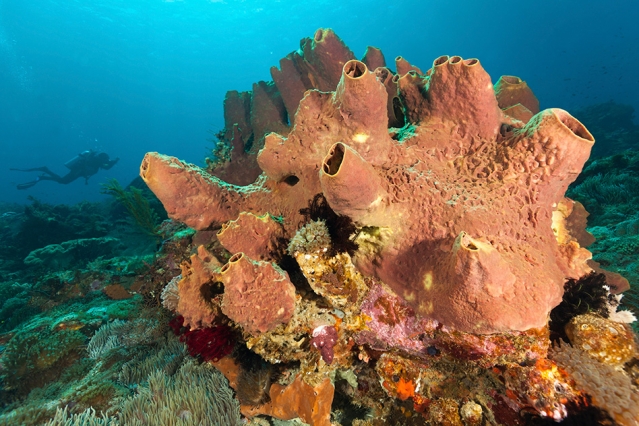
A team of MIT geochemists has unearthed new evidence in very old rocks suggesting that some of the first animals on Earth were likely ancestors of the modern sea sponge.In a study appearing today in the Proceedings of the National Academy of Sciences, the researchers report that they have identified “chemical fossils” that may have been left by ancient sponges in rocks that are more than 541 million years old. A chemical fossil is a remnant of a biomolecule that originated from a living organism that has since been buried, transformed, and preserved in sediment, sometimes for hundreds of millions of years.The newly identified chemical fossils are special types of steranes, which are the geologically stable form of sterols, such as cholesterol, that are found in the cell membranes of complex organisms. The researchers traced these special steranes to a class of sea sponges known as demosponges. Today, demosponges come in a huge variety of sizes and colors, and live throughout the oceans as soft and squishy filter feeders. Their ancient counterparts may have shared similar characteristics.“We don’t know exactly what these organisms would have looked like back then, but they absolutely would have lived in the ocean, they would have been soft-bodied, and we presume they didn’t have a silica skeleton,” says Roger Summons, the Schlumberger Professor of Geobiology Emeritus in MIT’s Department of Earth, Atmospheric and Planetary Sciences (EAPS).The group’s discovery of sponge-specific chemical fossils offers strong evidence that the ancestors of demosponges were among the first animals to evolve, and that they likely did so much earlier than the rest of Earth’s major animal groups.The study’s authors, including Summons, are lead author and former MIT EAPS Crosby Postdoctoral Fellow Lubna Shawar, who is now a research scientist at Caltech, along with Gordon Love from the University of California at Riverside, Benjamin Uveges of Cornell University, Alex Zumberge of GeoMark Research in Houston, Paco Cárdenas of Uppsala University in Sweden, and José-Luis Giner of the State University of New York College of Environmental Science and Forestry.Sponges on steroidsThe new study builds on findings that the group first reported in 2009. In that study, the team identified the first chemical fossils that appeared to derive from ancient sponges. They analyzed rock samples from an outcrop in Oman and found a surprising abundance of steranes that they determined were the preserved remnants of 30-carbon (C30) sterols — a rare form of steroid that they showed was likely derived from ancient sea sponges.The steranes were found in rocks that were very old and formed during the Ediacaran Period — which spans from roughly 541 million to about 635 million years ago. This period took place just before the Cambrian, when the Earth experienced a sudden and global explosion of complex multicellular life. The team’s discovery suggested that ancient sponges appeared much earlier than most multicellular life, and were possibly one of Earth’s first animals.However, soon after these findings were released, alternative hypotheses swirled to explain the C30 steranes’ origins, including that the chemicals could have been generated by other groups of organisms or by nonliving geological processes.The team says the new study reinforces their earlier hypothesis that ancient sponges left behind this special chemical record, as they have identified a new chemical fossil in the same Precambrian rocks that is almost certainly biological in origin.Building evidenceJust as in their previous work, the researchers looked for chemical fossils in rocks that date back to the Ediacaran Period. They acquired samples from drill cores and outcrops in Oman, western India, and Siberia, and analyzed the rocks for signatures of steranes, the geologically stable form of sterols found in all eukaryotes (plants, animals, and any organism with a nucleus and membrane-bound organelles).“You’re not a eukaryote if you don’t have sterols or comparable membrane lipids,” Summons says.A sterol’s core structure consists of four fused carbon rings. Additional carbon side chain and chemical add-ons can attach to and extend a sterol’s structure, depending on what an organism’s particular genes can produce. In humans, for instance, the sterol cholesterol contains 27 carbon atoms, while the sterols in plants generally have 29 carbon atoms.“It’s very unusual to find a sterol with 30 carbons,” Shawar says.The chemical fossil the researchers identified in 2009 was a 30-carbon sterol. What’s more, the team determined that the compound could be synthesized because of the presence of a distinctive enzyme which is encoded by a gene that is common to demosponges.In their new study, the team focused on the chemistry of these compounds and realized the same sponge-derived gene could produce an even rarer sterol, with 31 carbon atoms (C31). When they analyzed their rock samples for C31 steranes, they found it in surprising abundance, along with the aforementioned C30 steranes.“These special steranes were there all along,” Shawar says. “It took asking the right questions to seek them out and to really understand their meaning and from where they come.”The researchers also obtained samples of modern-day demosponges and analyzed them for C31 sterols. They found that, indeed, the sterols — biological precursors of the C31 steranes found in rocks — are present in some species of contemporary demosponges. Going a step further, they chemically synthesized eight different C31 sterols in the lab as reference standards to verify their chemical structures. Then, they processed the molecules in ways that simulate how the sterols would change when deposited, buried, and pressurized over hundreds of millions of years. They found that the products of only two such sterols were an exact match with the form of C31 sterols that they found in ancient rock samples. The presence of two and the absence of the other six demonstrates that these compounds were not produced by a random nonbiological process.The findings, reinforced by multiple lines of inquiry, strongly support the idea that the steranes that were found in ancient rocks were indeed produced by living organisms, rather than through geological processes. What’s more, those organisms were likely the ancestors of demosponges, which to this day have retained the ability to produce the same series of compounds.“It’s a combination of what’s in the rock, what’s in the sponge, and what you can make in a chemistry laboratory,” Summons says. “You’ve got three supportive, mutually agreeing lines of evidence, pointing to these sponges being among the earliest animals on Earth.”“In this study we show how to authenticate a biomarker, verifying that a signal truly comes from life rather than contamination or non-biological chemistry,” Shawar adds.Now that the team has shown C30 and C31 sterols are reliable signals of ancient sponges, they plan to look for the chemical fossils in ancient rocks from other regions of the world. They can only tell from the rocks they’ve sampled so far that the sediments, and the sponges, formed some time during the Ediacaran Period. With more samples, they will have a chance to narrow in on when some of the first animals took form.This research was supported, in part, by the MIT Crosby Fund, the Distinguished Postdoctoral Fellowship program, the Simons Foundation Collaboration on the Origins of Life, and the NASA Exobiology Program.

- Trending
- Comments
- Latest








Stay ahead with the latest insights on Hong Kong’s economy, finance, and investments. From market trends to policy updates, we bring you in-depth analysis and expert opinions.
📩 Subscribe to our newsletter for exclusive updates.
📍 Follow us on social media for real-time news.
📧 Contact us: info@hongkong-invest.com