









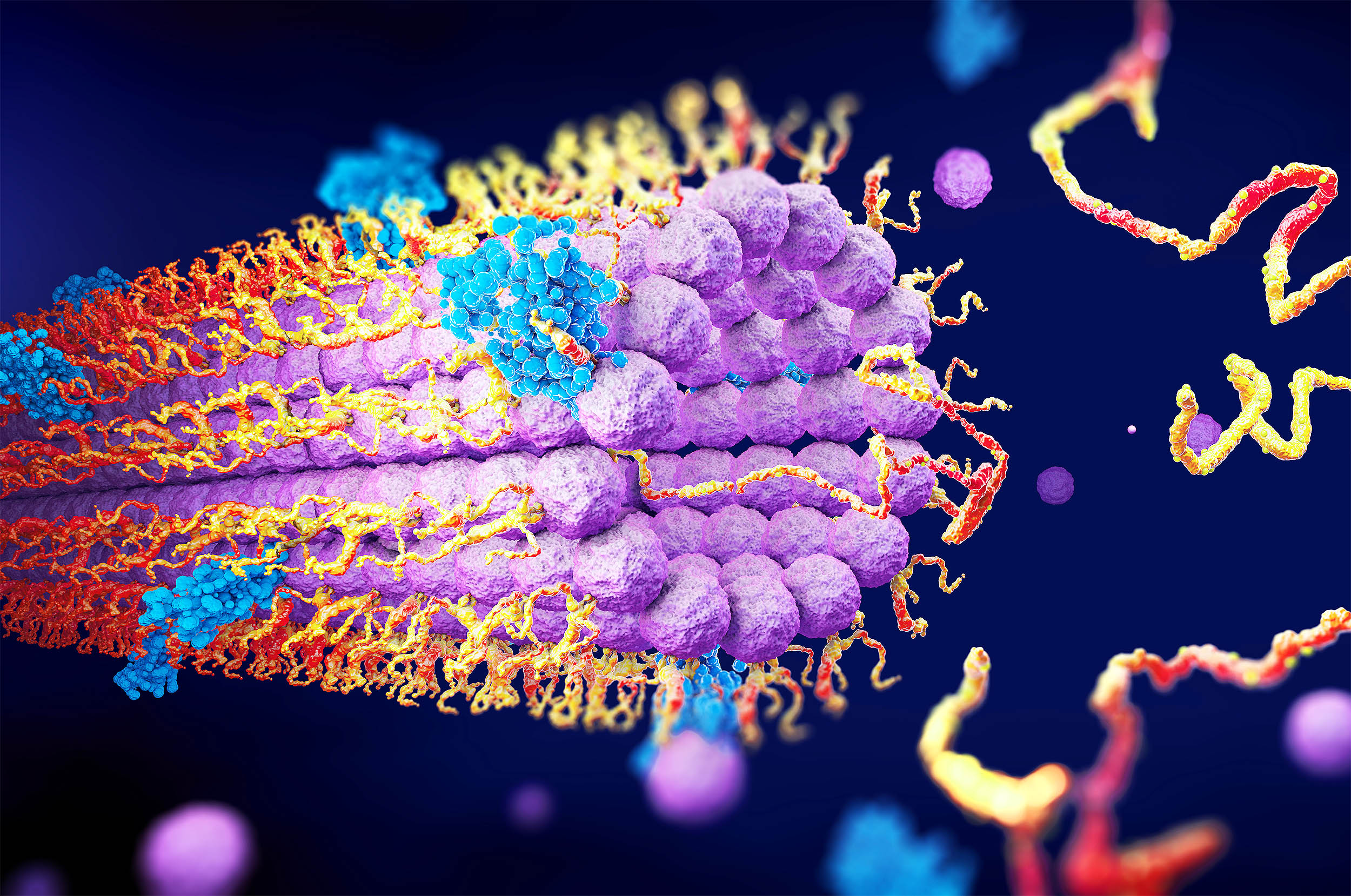
When cells are healthy, we don’t expect them to suddenly change cell types. A skin cell on your hand won’t naturally morph into a brain cell, and vice versa. That’s thanks to epigenetic memory, which enables the expression of various genes to “lock in” throughout a cell’s lifetime. Failure of this memory can lead to diseases, such as cancer.Traditionally, scientists have thought that epigenetic memory locks genes either “on” or “off” — either fully activated or fully repressed, like a permanent Lite-Brite pattern. But MIT engineers have found that the picture has many more shades.In a new study appearing today in Cell Genomics, the team reports that a cell’s memory is set not by on/off switching but through a more graded, dimmer-like dial of gene expression.The researchers carried out experiments in which they set the expression of a single gene at different levels in different cells. While conventional wisdom would assume the gene should eventually switch on or off, the researchers found that the gene’s original expression persisted: Cells whose gene expression was set along a spectrum between on and off remained in this in-between state.The results suggest that epigenetic memory — the process by which cells retain gene expression and “remember” their identity — is not binary but instead analog, which allows for a spectrum of gene expression and associated cell identities.“Our finding opens the possibility that cells commit to their final identity by locking genes at specific levels of gene expression instead of just on and off,” says study author Domitilla Del Vecchio, professor of mechanical and biological engineering at MIT. “The consequence is that there may be many more cell types in our body than we know and recognize today, that may have important functions and could underlie healthy or diseased states.”The study’s MIT lead authors are Sebastian Palacios and Simone Bruno, with additional co-authors.Beyond binaryEvery cell shares the same genome, which can be thought of as the starting ingredient for life. As a cell takes shape, it differentiates into one type or another, through the expression of genes in its genome. Some genes are activated, while others are repressed. The combination steers a cell toward one identity versus another.A process of DNA methylation, by which certain molecules attach to the genes’ DNA, helps lock their expression in place. DNA methylation assists a cell to “remember” its unique pattern of gene expression, which ultimately establishes the cell’s identity.Del Vecchio’s group at MIT applies mathematics and genetic engineering to understand cellular molecular processes and to engineer cells with new capabilities. In previous work, her group was experimenting with DNA methylation and ways to lock the expression of certain genes in ovarian cells.“The textbook understanding was that DNA methylation had a role to lock genes in either an on or off state,” Del Vecchio says. “We thought this was the dogma. But then we started seeing results that were not consistent with that.”While many of the cells in their experiment exhibited an all-or-nothing expression of genes, a significant number of cells appeared to freeze genes in an in-between state — neither entirely on or off.“We found there was a spectrum of cells that expressed any level between on and off,” Palacios says. “And we thought, how is this possible?”Shades of blueIn their new study, the team aimed to see whether the in-between gene expression they observed was a fluke or a more established property of cells that until now has gone unnoticed.“It could be that scientists disregarded cells that don’t have a clear commitment, because they assumed this was a transient state,” Del Vecchio says. “But actually these in-between cell types may be permanent states that could have important functions.”To test their idea, the researchers ran experiments with hamster ovarian cells — a line of cells commonly used in the laboratory. In each cell, an engineered gene was initially set to a different level of expression. The gene was turned fully on in some cells, completely off in others, and set somewhere in between on and off for the remaining cells.The team paired the engineered gene with a fluorescent marker that lights up with a brightness corresponding to the gene’s level of expression. The researchers introduced, for a short time, an enzyme that triggers the gene’s DNA methylation, a natural gene-locking mechanism. They then monitored the cells over five months to see whether the modification would lock the genes in place at their in-between expression levels, or whether the genes would migrate toward fully on or off states before locking in.“Our fluorescent marker is blue, and we see cells glow across the entire spectrum, from really shiny blue, to dimmer and dimmer, to no blue at all,” Del Vecchio says. “Every intensity level is maintained over time, which means gene expression is graded, or analog, and not binary. We were very surprised, because we thought after such a long time, the gene would veer off, to be either fully on or off, but it did not.”The findings open new avenues into engineering more complex artificial tissues and organs by tuning the expression of certain genes in a cell’s genome, like a dial on a radio, rather than a switch. The results also complicate the picture of how a cell’s epigenetic memory works to establish its identity. It opens up the possibility that cell modifications such as those exhibited in therapy-resistant tumors could be treated in a more precise fashion.“Del Vecchio and colleagues have beautifully shown how analog memory arises through chemical modifications to the DNA itself,” says Michael Elowitz, professor of biology and biological engineering at the California institute of Technology, who was not involved in the study. “As a result, we can now imagine repurposing this natural analog memory mechanism, invented by evolution, in the field of synthetic biology, where it could help allow us to program permanent and precise multicellular behaviors.”“One of the things that enables the complexity in humans is epigenetic memory,” Palacios says. “And we find that it is not what we thought. For me, that’s actually mind-blowing. And I think we’re going to find that this analog memory is relevant for many different processes across biology.”This research was supported, in part, by the National Science Foundation, MODULUS, and a Vannevar Bush Faculty Fellowship through the U.S. Office of Naval Research.

- Trending
- Comments
- Latest








Stay ahead with the latest insights on Hong Kong’s economy, finance, and investments. From market trends to policy updates, we bring you in-depth analysis and expert opinions.
📩 Subscribe to our newsletter for exclusive updates.
📍 Follow us on social media for real-time news.
📧 Contact us: info@hongkong-invest.com