







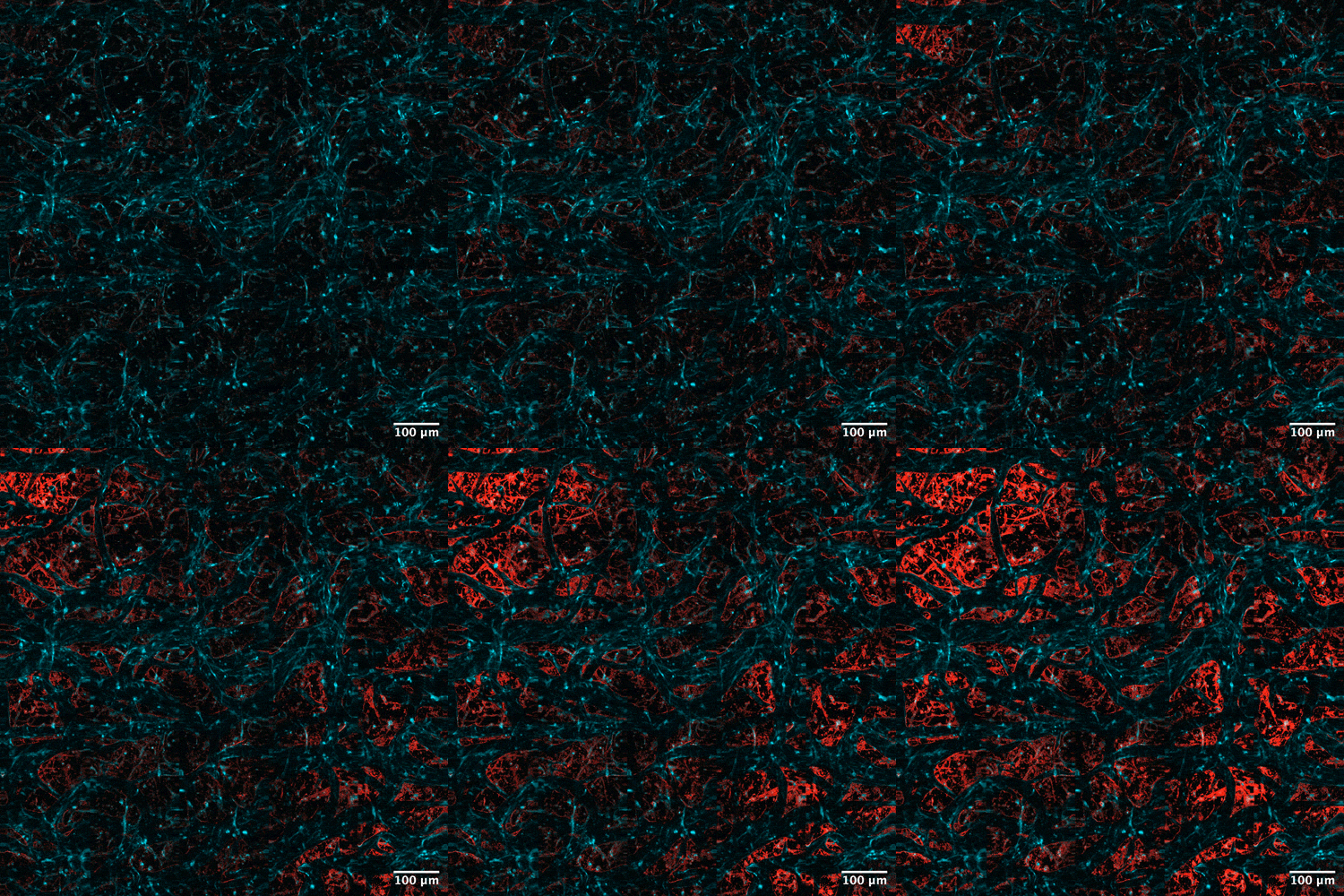
MIT researchers discovered a paradoxical phenomenon in optical physics that could enable a new bioimaging method that’s faster and higher-resolution than existing technology.They discovered that, under the right conditions, a chaotic mess of laser light can spontaneously self-organize into a highly focused “pencil beam.”Using this self-organized pencil beam, the researchers captured 3D images of the human blood-brain barrier 25 times faster than the gold-standard method, while maintaining comparable resolution.By showing individual cells absorbing drugs in real-time, this technology could help scientists test whether new drugs for neurodegenerative disease like Alzheimer’s or ALS reach their targets in the brain, with greater speed and resolution.“The common belief in the field is that if you crank up the power in this type of laser, the light will inevitably become chaotic. But we proved that this is not the case. We followed the evidence, embraced the uncertainty, and found a way to let the light organize itself into a novel solution for bioimaging,” says Sixian You, assistant professor in the MIT Department of Electrical Engineering and Computer Science (EECS), a member of the Research Laboratory for Electronics, and senior author of a paper on this imaging technique.She is joined on the paper by lead author Honghao Cao, an EECS graduate student; EECS graduate students Li-Yu Yu and Kunzan Liu; postdocs Sarah Spitz, Francesca Michela Pramotton, and Federico Presutti; Zhengyu Zhang PhD ’24; Subhash Kulkarni, an assistant professor at Harvard University and the Beth Israel Deaconess Medical Center; and Roger Kamm, the Cecil and Ida Green Distinguished Professor of Biological and Mechanical Engineering at MIT. The paper appears today in Nature Methods.A surprising findingThe discovery began with an observation that initially puzzled the researchers.The team previously developed a precise fiber shaper, a device that enables them to carefully tune the laser light shining through a multimode optical fiber. This type of optical fiber can carry a significant amount of power.Cao was pushing the multimode fiber toward its limit to see how much power it could take.Typically, the more power one pumps into the laser, the more disordered and scattered the beam of light becomes due to imperfections in the fiber.But Cao observed that, as he increased the power almost to the point where it would burn the fiber, the light did the opposite of what was expected: It collapsed into a single, needle-sharp beam.“Disorder is intrinsic to these fibers. The light engineering you typically need to do to overcome that disorder, especially at high power, is a longstanding hassle. But with this self-organization, you can get a stable, ultrafast pencil beam without the need for custom beam-shaping components,” You says.To replicate this phenomenon, the researchers found they had to satisfy two simple, but precise conditions.First, the laser must enter the fiber at a perfect, zero-degree angle. This is a more rigorous requirement than is usually used for these types of fibers. Second, the power must be dialed up until the light begins to interact with the glass of the fiber itself.“At this critical power, the nonlinearity can counter the intrinsic disorder, creating a balance that transforms the input beam into a self-organized pencil beam,” Cao explains.Typically, researchers conduct these experiments at much lower power levels for fear of destroying the fiber, in which case they wouldn’t see this self-organization. In addition, such precise on-axis alignment isn’t typically necessary since a multimode fiber can carry so much power.But taken together, these two techniques can generate a stable pencil-beam without any complicated light engineering methods.“That is the charm of this method — you could do this with a normal, optical setup and without much domain expertise,” You says.A better beamWhen the researchers performed characterization experiments of this pencil beam, it was more stable and high-resolution than many similar beams. Other beams often suffer from “sidelobes” — blurry halos of light that can distort images.Their beam was more pristine and tightly focused.Building on those experiments, the researchers demonstrated the use of this pencil-beam in biomedical imaging of the human blood-brain barrier.This barrier is a tightly packed layer of cells that protects the brain from toxins, but it also blocks many medicines. Scientists and clinicians often want to see how drugs flow inside the vasculature of the blood-brain barrier and whether they reach their targets within the brain.But with standard optical settings, the best one can do is capture one 2D section of the vasculature at a time, and then repeat the process multiple times to generate a fuller image, You explains.Using this new technique, the researchers created an ultrafast, high-precision pencil beam that enabled them to dynamically track how cells absorb proteins in real-time.“The pharmaceutical industry is especially interested in using human-based models to screen for drugs that effectively cross the barrier, as animal models often fail to predict what happens in humans. That this new method doesn’t require the cells to have a fluorescent tag is a game-changer. For the first time, we can now visualize the time-dependent entry of drugs into the brain and even identify the rate at which specific cell types internalize the drug,” says Kamm.“Importantly, however, this approach is not limited to the blood-brain barrier but enables time-resolved tracking of diverse compounds and molecular targets across engineered tissue models, providing a powerful tool for biological engineering,” Spitz adds.The team captured cellular-level 3D images that were higher quality than with other methods, and generated these images about 25 times faster.“Usually, you have a tradeoff between image resolution and depth of focus — you can only probe so far at a time. But with our method, we can overcome this tradeoff by creating a pencil-beam with both high resolution and a large depth of focus,” You says.In the future, the researchers want to better understand the fundamental physics of the pencil-beam and the mechanisms behind its self-organization. They also plan to apply the technique to other scenarios, such as imaging neurons in the brain, and work toward commercializing the technology.“You’s group realized this beam that concentrates energy in time and space could be valuable for microscopy techniques that depend on the intensity of the light that illuminates the sample. They demonstrated just that and found advantages over ordinary laser beams for imaging. It will be scientifically interesting to fully understand the creation of the new pencil beams, which could find use in a variety of imaging applications,” says Frank Wise, the Samuel B. Eckert Professor of Engineering Emeritus at Cornell University, who was not involved with this work.This work was funded, in part, by MIT startup funds, the National Science Foundation (NSF), the Silicon Valley Community Foundation, Diacomp Foundation, the Harvard Digestive Disease Core, a MathWorks Fellowship, and the Claude E. Shannon Award.

- Trending
- Comments
- Latest

Recent News



Stay ahead with the latest insights on Hong Kong’s economy, finance, and investments. From market trends to policy updates, we bring you in-depth analysis and expert opinions.
📩 Subscribe to our newsletter for exclusive updates.
📍 Follow us on social media for real-time news.
📧 Contact us: info@hongkong-invest.com