









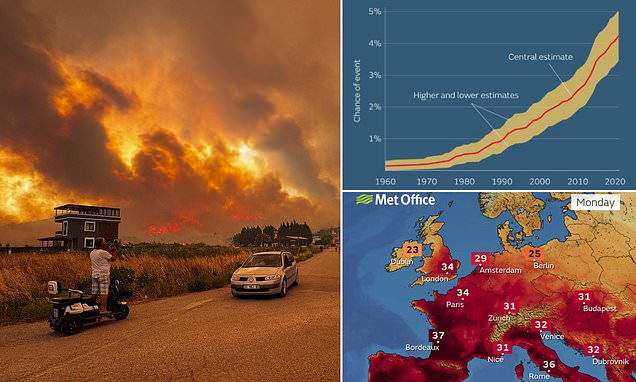
A long stretch of humid heat followed by intense thunderstorms is a weather pattern historically seen mostly in and around the tropics. But climate change is making humid heat waves and extreme storms more common in traditionally temperate midlatitude regions such as the midwestern U.S., which has seen episodes of unusually high heat and humidity in recent summers.Now, MIT scientists have identified a key condition in the atmosphere that determines how hot and humid a midlatitude region can get, and how intense related storms can become. The results may help climate scientists gauge a region’s risk for humid heat waves and extreme storms as the world continues to warm.In a study appearing this week in the journal Science Advances, the MIT team reports that a region’s maximum humid heat and storm intensity are limited by the strength of an “atmospheric inversion”— a weather condition in which a layer of warm air settles over cooler air.Inversions are known to act as an atmospheric blanket that traps pollutants at ground level. Now, the MIT researchers have found atmospheric inversions also trap and build up heat and moisture at the surface, particularly in midlatitude regions. The more persistent an inversion, the more heat and humidity a region can accumulate at the surface, which can lead to more oppressive, longer-lasting humid heat waves.And, when an inversion eventually weakens, the accumulated heat energy is released as convection, which can whip up the hot and humid air into intense thunderstorms and heavy rainfall.The team says this effect is especially relevant for midlatitude regions, where atmospheric inversions are common. In the U.S., regions to the east of the Rocky Mountains often experience inversions of this kind, with relatively warm air aloft sitting over cooler air near the surface.As climate change further warms the atmosphere in general, the team suspects that inversions may become more persistent and harder to break. This could mean more frequent humid heat waves and more intense storms for places that are not accustomed to such extreme weather.“Our analysis shows that the eastern and midwestern regions of U.S. and the eastern Asian regions may be new hotspots for humid heat in the future climate,” says study author Funing Li, a postdoc in MIT’s Department of Earth, Atmospheric and Planetary Sciences (EAPS).“As the climate warms, theoretically the atmosphere will be able to hold more moisture,” adds co-author and EAPS Assistant Professor Talia Tamarin-Brodsky. “Which is why new regions in the midlatitudes could experience moist heat waves that will cause stress that they weren’t used to before.”Air energeticsThe atmosphere’s layers generally get colder with altitude. In these typical conditions, when a heat wave comes through a region, it warms the air at ground level. Since warm air is lighter than cold air, it will eventually rise, like a hot air balloon, prompting colder air to sink. This rise and fall of air sets off convection, like bubbles in boiling water. When warm air hits colder altitudes, it condenses into droplets that rain out, typically as a thunderstorm, that can often relieve a heat wave.For their new study, Li and Tamarin-Brodsky wondered: What would it take to get air at the surface to convect and ultimately end a heat wave? Put another way: What sets the limit to how hot a region can get before air begins to convect to eventually rain?The team treated the question as a problem of energy. Heat is energy that can be thought of in two forms: the energy that comes from dry heat (i.e., temperature), and the energy that comes from latent, or moist, heat. The scientists reasoned that, for a given portion or “parcel” of air, there is some amount of moisture that, when condensed, contributes to that air parcel’s total energy. Depending on how much energy an air parcel has, it could start to convect, rise up, and eventually rain out.“Imagine putting a balloon around a parcel of air and asking, will it stay in the same place, will it go up, or will it sink?” Tamarin-Brodsky says. “It’s not just about warm air that’s lifting. You also have to think about the moisture that’s there. So we consider the energetics of an air parcel while taking into account the moisture in that air. Then we can find the maximum ‘moist energy’ that can accumulate near the surface before the air becomes unstable and convects.”Heat barrierAs they worked through their analysis, the researchers found that the maximum amount of moist energy, or the highest level of heat and humidity that the air can hold, is set by the presence and strength of an atmospheric inversion. In cases where atmospheric layers are inverted (when a layer of warm or light air settles over colder or heavier, ground-level air), the air has to accumulate more heat and moisture in order for an air parcel to build up enough energy to lift up and break through the inversion layer. The more persistent the inversion is, the hotter and more humid air must get before it can rise up and convect.Their analysis suggests that an atmospheric inversion can increase a region’s capacity to hold heat and humidity. How high this heat and humidity can get depends on how stable the inversion is. If a blanket of warm air parks over a region without moving, it allows more humid heat to build up, versus if the blanket is quickly removed. When the air eventually convects, the accumulated heat and moisture will generate stronger, more intense storms.“This increasing inversion has two effects: more severe humid heat waves, and less frequent but more extreme convective storms,” Tamarin-Brodsky says.Inversions in the atmosphere form in various ways. At night, the surface that warmed during the day cools by radiating heat to space, making the air in contact with it cooler and denser than the air above. This creates a shallow layer in which temperature increases with height, called a nocturnal inversion. Inversions can also form when a shallow layer of cool marine air moves inland from the ocean and slides beneath warmer air over the land, leaving cool air near the surface and warmer air above. In some cases, persistent inversions can form when air heated over sun-warmed mountains is carried over colder low-lying regions, so that a warm layer aloft caps cooler air near the ground.“The Great Plains and the Midwest have had many inversions historically due to the Rocky Mountains,” Li says. “The mountains act as an efficient elevated heat source, and westerly winds carry this relatively warm air downstream into the central and midwestern U.S., where it can help create a persistent temperature inversion that caps colder air near the surface.”“In a future climate for the Midwest, they may experience both more severe thunderstorms and more extreme humid heat waves,” Tamarin-Brodsky says. “Our theory gives an understanding of the limit for humid heat and severe convection for these communities that will be future heat wave and thunderstorm hotspots.”This research is part of the MIT Climate Grand Challenge on Weather and Climate Extremes. Support was provided by Schmidt Sciences.

- Trending
- Comments
- Latest








Stay ahead with the latest insights on Hong Kong’s economy, finance, and investments. From market trends to policy updates, we bring you in-depth analysis and expert opinions.
📩 Subscribe to our newsletter for exclusive updates.
📍 Follow us on social media for real-time news.
📧 Contact us: info@hongkong-invest.com