









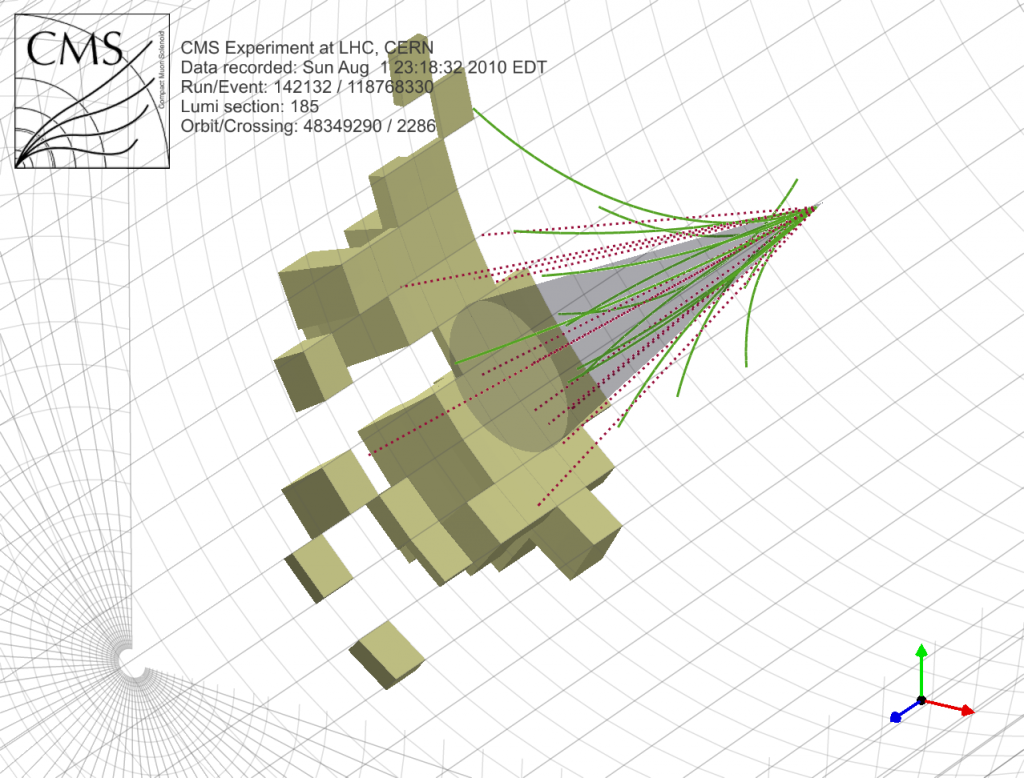
A new and powerful particle detector just passed a critical test in its goal to decipher the ingredients of the early universe.The sPHENIX detector is the newest experiment at Brookhaven National Laboratory’s Relativistic Heavy Ion Collider (RHIC) and is designed to precisely measure products of high-speed particle collisions. From the aftermath, scientists hope to reconstruct the properties of quark-gluon plasma (QGP) — a white-hot soup of subatomic particles known as quarks and gluons that is thought to have sprung into existence in the few microseconds following the Big Bang. Just as quickly, the mysterious plasma disappeared, cooling and combining to form the protons and neutrons that make up today’s ordinary matter.Now, the sPHENIX detector has made a key measurement that proves it has the precision to help piece together the primordial properties of quark-gluon plasma.In a paper in the Journal of High Energy Physics, scientists including physicists at MIT report that sPHENIX precisely measured the number and energy of particles that streamed out from gold ions that collided at close to the speed of light.Straight aheadThis test is considered in physics to be a “standard candle,” meaning that the measurement is a well-established constant that can be used to gauge a detector’s precision.In particular, sPHENIX successfully measured the number of charged particles that are produced when two gold ions collide, and determined how this number changes when the ions collide head-on, versus just glancing by. The detector’s measurements revealed that head-on collisions produced 10 times more charged particles, which were also 10 times more energetic, compared to less straight-on collisions.“This indicates the detector works as it should,” says Gunther Roland, professor of physics at MIT, who is a member and former spokesperson for the sPHENIX Collaboration. “It’s as if you sent a new telescope up in space after you’ve spent 10 years building it, and it snaps the first picture. It’s not necessarily a picture of something completely new, but it proves that it’s now ready to start doing new science.”“With this strong foundation, sPHENIX is well-positioned to advance the study of the quark-gluon plasma with greater precision and improved resolution,” adds Hao-Ren Jheng, a graduate student in physics at MIT and a lead co-author of the new paper. “Probing the evolution, structure, and properties of the QGP will help us reconstruct the conditions of the early universe.”The paper’s co-authors are all members of the sPHENIX Collaboration, which comprises over 300 scientists from multiple institutions around the world, including Roland, Jheng, and physicists at MIT’s Bates Research and Engineering Center.“Gone in an instant”Particle colliders such as Brookhaven’s RHIC are designed to accelerate particles at “relativistic” speeds, meaning close to the speed of light. When these particles are flung around in opposite, circulating beams and brought back together, any smash-ups that occur can release an enormous amount of energy. In the right conditions, this energy can very briefly exist in the form of quark-gluon plasma — the same stuff that sprung out of the Big Bang.Just as in the early universe, quark-gluon plasma doesn’t hang around for very long in particle colliders. If and when QGP is produced, it exists for just 10 to the minus 22, or about a sextillionth, of a second. In this moment, quark-gluon plasma is incredibly hot, up to several trillion degrees Celsius, and behaves as a “perfect fluid,” moving as one entity rather than as a collection of random particles. Almost immediately, this exotic behavior disappears, and the plasma cools and transitions into more ordinary particles such as protons and neutrons, which stream out from the main collision.“You never see the QGP itself — you just see its ashes, so to speak, in the form of the particles that come from its decay,” Roland says. “With sPHENIX, we want to measure these particles to reconstruct the properties of the QGP, which is essentially gone in an instant.”“One in a billion”The sPHENIX detector is the next generation of Brookhaven’s original Pioneering High Energy Nuclear Interaction eXperiment, or PHENIX, which measured collisions of heavy ions generated by RHIC. In 2021, sPHENIX was installed in place of its predecessor, as a faster and more powerful version, designed to detect quark-gluon plasma’s more subtle and ephemeral signatures.The detector itself is about the size of a two-story house and weighs around 1,000 tons. It sits at the intersection of RHIC’s two main collider beams, where relativistic particles, accelerated from opposite directions, meet and collide, producing particles that fly out into the detector. The sPHENIX detector is able to catch and measure 15,000 particle collisions per second, thanks to its novel, layered components, including the MVTX, or micro-vertex — a subdetector that was designed, built, and installed by scientists at MIT’s Bates Research and Engineering Center.Together, the detector’s systems enable sPHENIX to act as a giant 3D camera that can track the number, energy, and paths of individual particles during an explosion of particles generated by a single collision.“SPHENIX takes advantage of developments in detector technology since RHIC switched on 25 years ago, to collect data at the fastest possible rate,” says MIT postdoc Cameron Dean, who was a main contributor to the new study’s analysis. “This allows us to probe incredibly rare processes for the first time.”In the fall of 2024, scientists ran the detector through the “standard candle” test to gauge its speed and precision. Over three weeks, they gathered data from sPHENIX as the main collider accelerated and smashed together beams of gold ions traveling at the speed of light. Their analysis of the data showed that sPHENIX accurately measured the number of charged particles produced in individual gold ion collisions, as well as the particles’ energies. What’s more, the detector was sensitive to a collision’s “head-on-ness,” and could observe that head-on collisions produced more particles with greater energy, compared to less direct collisions.“This measurement provides clear evidence that the detector is functioning as intended,” Jheng says.“The fun for sPHENIX is just beginning,” Dean adds. “We are currently back colliding particles and expect to do so for several more months. With all our data, we can look for the one-in-a-billion rare process that could give us insights on things like the density of QGP, the diffusion of particles through ultra-dense matter, and how much energy it takes to bind different particles together.”This work was supported, in part, by the U.S. Department of Energy Office of Science, and the National Science Foundation.

- Trending
- Comments
- Latest








Stay ahead with the latest insights on Hong Kong’s economy, finance, and investments. From market trends to policy updates, we bring you in-depth analysis and expert opinions.
📩 Subscribe to our newsletter for exclusive updates.
📍 Follow us on social media for real-time news.
📧 Contact us: info@hongkong-invest.com