







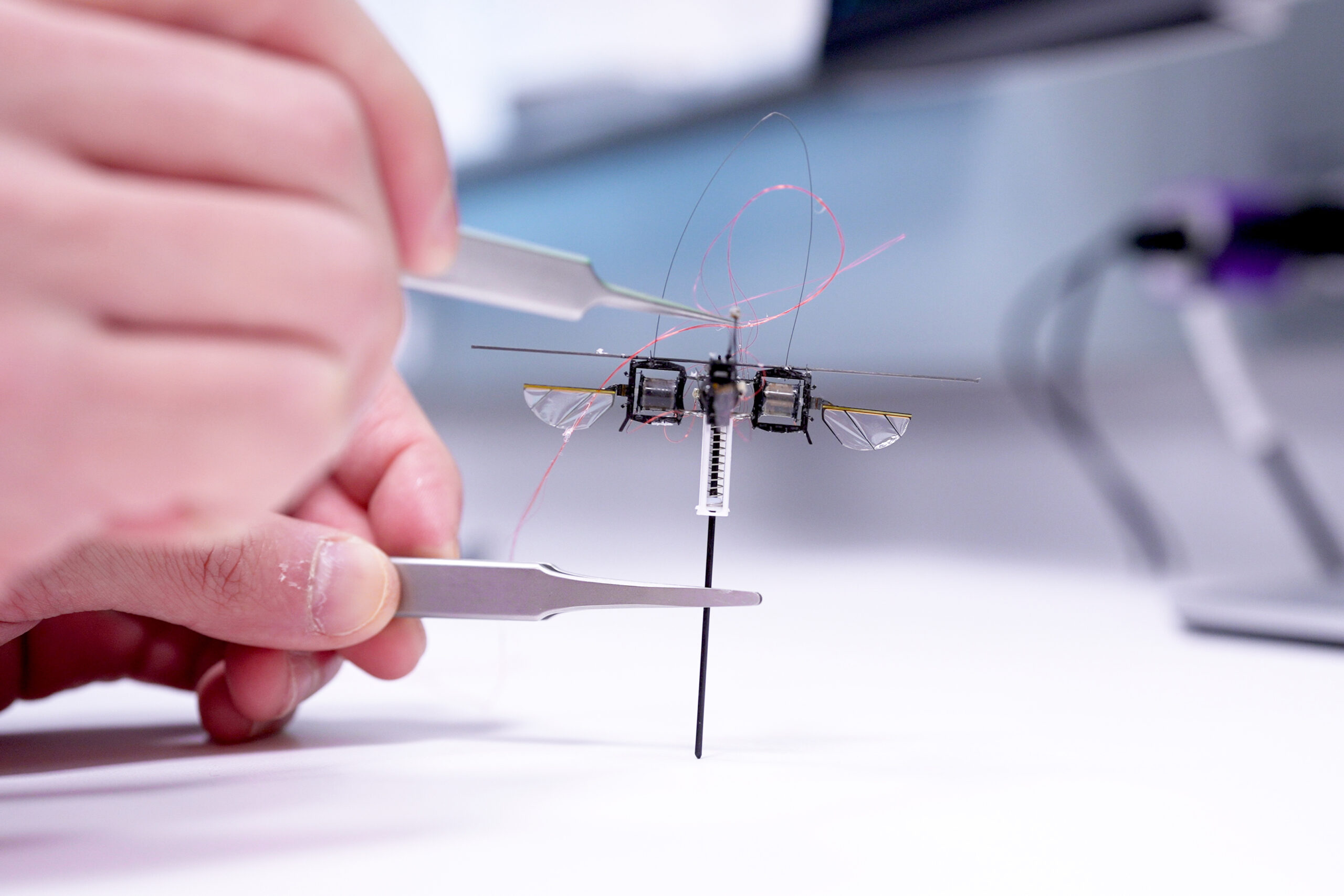
Insect-scale robots can squeeze into places their larger counterparts can’t, like deep into a collapsed building to search for survivors after an earthquake.However, as they move through the rubble, tiny crawling robots might encounter tall obstacles they can’t climb over or slanted surfaces they will slide down. While aerial robots could avoid these hazards, the amount of energy required for flight would severely limit how far the robot can travel into the wreckage before it needs to return to base and recharge.To get the best of both locomotion methods, MIT researchers developed a hopping robot that can leap over tall obstacles and jump across slanted or uneven surfaces, while using far less energy than an aerial robot.The hopping robot, which is smaller than a human thumb and weighs less than a paperclip, has a springy leg that propels it off the ground, and four flapping-wing modules that give it lift and control its orientation.The robot can jump about 20 centimeters into the air, or four times its height, at a lateral speed of about 30 centimeters per second, and has no trouble hopping across ice, wet surfaces, and uneven soil, or even onto a hovering drone. All the while, the hopping robot consumes about 60 percent less energy than its flying cousin.Due to its light weight and durability, and the energy efficiency of the hopping process, the robot could carry about 10 times more payload than a similar-sized aerial robot, opening the door to many new applications.“Being able to put batteries, circuits, and sensors on board has become much more feasible with a hopping robot than a flying one. Our hope is that one day this robot could go out of the lab and be useful in real-world scenarios,” says Yi-Hsuan (Nemo) Hsiao, an MIT graduate student and co-lead author of a paper on the hopping robot.Hsiao is joined on the paper by co-lead authors Songnan Bai, a research assistant professor at the City University of Hong Kong; and Zhongtao Guan, an incoming MIT graduate student who completed this work as a visiting undergraduate; as well as Suhan Kim and Zhijian Ren of MIT; and senior authors Pakpong Chirarattananon, an associate professor of the City University of Hong Kong; and Kevin Chen, an associate professor in the MIT Department of Electrical Engineering and Computer Science and head of the Soft and Micro Robotics Laboratory within the Research Laboratory of Electronics. The research appears today in Science Advances.Maximizing efficiencyJumping is common among insects, from fleas that leap onto new hosts to grasshoppers that bound around a meadow. While jumping is less common among insect-scale robots, which usually fly or crawl, hopping affords many advantages for energy efficiency.When a robot hops, it transforms potential energy, which comes from its height off the ground, into kinetic energy as it falls. This kinetic energy transforms back to potential energy when it hits the ground, then back to kinetic as it rises, and so on.To maximize efficiency of this process, the MIT robot is fitted with an elastic leg made from a compression spring, which is akin to the spring on a click-top pen. This spring converts the robot’s downward velocity to upward velocity when it strikes the ground.“If you have an ideal spring, your robot can just hop along without losing any energy. But since our spring is not quite ideal, we use the flapping modules to compensate for the small amount of energy it loses when it makes contact with the ground,” Hsiao explains.As the robot bounces back up into the air, the flapping wings provide lift, while ensuring the robot remains upright and has the correct orientation for its next jump. Its four flapping-wing mechanisms are powered by soft actuators, or artificial muscles, that are durable enough to endure repeated impacts with the ground without being damaged.“We have been using the same robot for this entire series of experiments, and we never needed to stop and fix it,” Hsiao adds.Key to the robot’s performance is a fast control mechanism that determines how the robot should be oriented for its next jump. Sensing is performed using an external motion-tracking system, and an observer algorithm computes the necessary control information using sensor measurements.As the robot hops, it follows a ballistic trajectory, arcing through the air. At the peak of that trajectory, it estimates its landing position. Then, based on its target landing point, the controller calculates the desired takeoff velocity for the next jump. While airborne, the robot flaps its wings to adjust its orientation so it strikes the ground with the correct angle and axis to move in the proper direction and at the right speed.Durability and flexibilityThe researchers put the hopping robot, and its control mechanism, to the test on a variety of surfaces, including grass, ice, wet glass, and uneven soil — it successfully traversed all surfaces. The robot could even hop on a surface that was dynamically tilting.“The robot doesn’t really care about the angle of the surface it is landing on. As long as it doesn’t slip when it strikes the ground, it will be fine,” Hsiao says.Since the controller can handle multiple terrains, the robot can easily transition from one surface to another without missing a beat.For instance, hopping across grass requires more thrust than hopping across glass, since blades of grass cause a damping effect that reduces its jump height. The controller can pump more energy to the robot’s wings during its aerial phase to compensate.Due to its small size and light weight, the robot has an even smaller moment of inertia, which makes it more agile than a larger robot and better able to withstand collisions.The researchers showcased its agility by demonstrating acrobatic flips. The featherweight robot could also hop onto an airborne drone without damaging either device, which could be useful in collaborative tasks.In addition, while the team demonstrated a hopping robot that carried twice its weight, the maximum payload may be much higher. Adding more weight doesn’t hurt the robot’s efficiency. Rather, the efficiency of the spring is the most significant factor that limits how much the robot can carry.Moving forward, the researchers plan to leverage its ability to carry heavy loads by installing batteries, sensors, and other circuits onto the robot, in the hopes of enabling it to hop autonomously outside the lab.“Multimodal robots (those combining multiple movement strategies) are generally challenging and particularly impressive at such a tiny scale. The versatility of this tiny multimodal robot — flipping, jumping on rough or moving terrain, and even another robot — makes it even more impressive,” says Justin Yim, assistant professor at the University of Illinois at Urbana-Champagne, who was not involved with this work. “Continuous hopping shown in this research enables agile and efficient locomotion in environments with many large obstacles.”This research is funded, in part, by the U.S. National Science Foundation and the MIT MISTI program. Chirarattananon was supported by the Research Grants Council of the Hong Kong Special Administrative Region of China. Hsiao is supported by a MathWorks Fellowship, and Kim is supported by a Zakhartchenko Fellowship.

- Trending
- Comments
- Latest


Recent News

Stay ahead with the latest insights on Hong Kong’s economy, finance, and investments. From market trends to policy updates, we bring you in-depth analysis and expert opinions.
📩 Subscribe to our newsletter for exclusive updates.
📍 Follow us on social media for real-time news.
📧 Contact us: info@hongkong-invest.com