









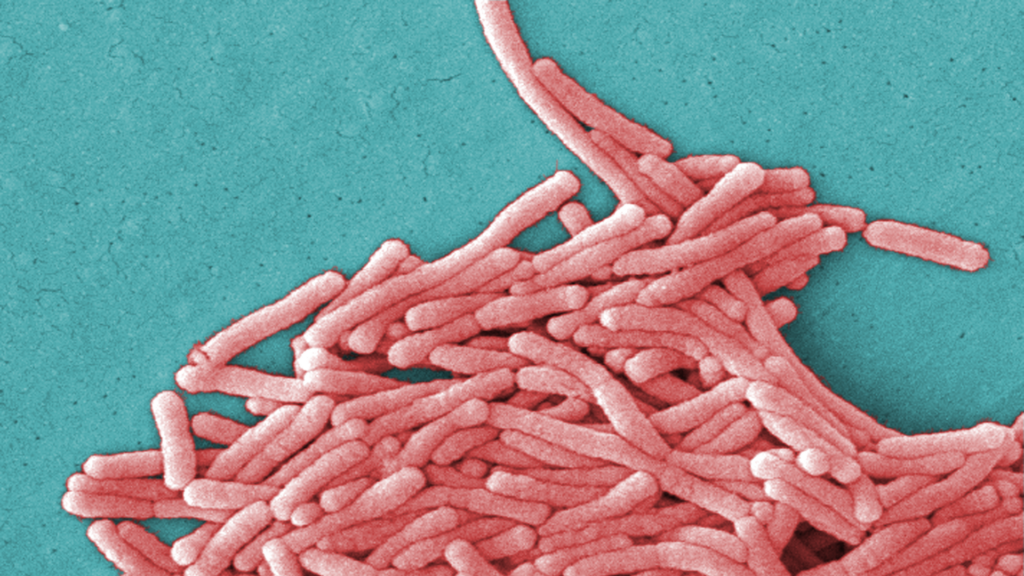
Bacteria can be engineered to sense a variety of molecules, such as pollutants or soil nutrients. In most cases, however, these signals can only be detected by looking at the cells under a microscope, making them impractical for large-scale use.Using a new method that triggers cells to produce molecules that generate unique combinations of color, MIT engineers have shown that they can read out these bacterial signals from as far as 90 meters away. Their work could lead to the development of bacterial sensors for agricultural and other applications, which could be monitored by drones or satellites.“It’s a new way of getting information out of the cell. If you’re standing next to it, you can’t see anything by eye, but from hundreds of meters away, using specific cameras, you can get the information when it turns on,” says Christopher Voigt, head of MIT’s Department of Biological Engineering and the senior author of the new study.In a paper appearing today in Nature Biotechnology, the researchers showed that they could engineer two different types of bacteria to produce molecules that give off distinctive wavelengths of light across the visible and infrared spectra of light, which can be imaged with hyperspectral cameras. These reporting molecules were linked to genetic circuits that detect nearby bacteria, but this approach could also be combined with any existing sensor, such as those for arsenic or other contaminants, the researchers say.“The nice thing about this technology is that you can plug and play whichever sensor you want,” says Yonatan Chemla, an MIT postdoc who is one of the lead authors of the paper. “There is no reason that any sensor would not be compatible with this technology.”Itai Levin PhD ’24 is also a lead author of the paper. Other authors include former undergraduate students Yueyang Fan ’23 and Anna Johnson ’22, and Connor Coley, an associate professor of chemical engineering at MIT.Hyperspectral imagingThere are many ways to engineer bacterial cells so that they can sense a particular chemical. Most of these work by connecting detection of a molecule to an output such as green fluorescent protein (GFP). These work well for lab studies, but such sensors can’t be measured from long distances.For long-distance sensing, the MIT team came up with the idea to engineer cells to produce hyperspectral reporter molecules, which can be detected using hyperspectral cameras. These cameras, which were first invented in the 1970s, can determine how much of each color wavelength is present in any given pixel. Instead of showing up as simply red or green, each pixel contains information on hundreds different wavelengths of light.Currently, hyperspectral cameras are used for applications such as detecting the presence of radiation. In the areas around Chernobyl, these cameras have been used to measure slight color changes that radioactive metals produce in the chlorophyll of plant cells. Hyperspectral cameras are also used to look for signs of malnutrition or pathogen invasion in plants.That work inspired the MIT team to explore whether they could engineer bacterial cells to produce hyperspectral reporters when they detect a target molecule.For a hyperspectral reporter to be most useful, it should have a spectral signature with peaks in multiple wavelengths of light, making it easier to detect. The researchers performed quantum calculations to predict the hyperspectral signatures of about 20,000 naturally occurring cell molecules, allowing them to identify those with the most unique patterns of light emission. Another key feature is the number of enzymes that would need to be engineered into a cell to get it to produce the reporter — a trait that will vary for different types of cells.“The ideal molecule is one that’s really different from everything else, making it detectable, and requires the fewest number of enzymes to produce it in the cell,” Voigt says.In this study, the researchers identified two different molecules that were best suited for two types of bacteria. For a soil bacterium called Pseudomonas putida, they used a reporter called biliverdin — a pigment that results from the breakdown of heme. For an aquatic bacterium called Rubrivivax gelatinosus, they used a type of bacteriochlorophyll. For each bacterium, the researchers engineered the enzymes necessary to produce the reporter into the host cell, then linked them to genetically engineered sensor circuits.“You could add one of these reporters to a bacterium or any cell that has a genetically encoded sensor in its genome. So, it might respond to metals or radiation or toxins in the soil, or nutrients in the soil, or whatever it is you want it to respond to. Then the output of that would be the production of this molecule that can then be sensed from far away,” Voigt says.Long-distance sensingIn this study, the researchers linked the hyperspectral reporters to circuits designed for quorum sensing, which allow cells to detect other nearby bacteria. They have also shown, in work done after this paper, that these reporting molecules can be linked to sensors for chemicals including arsenic.When testing their sensors, the researchers deployed them in boxes so they would remain contained. The boxes were placed in fields, deserts, or on the roofs of buildings, and the cells produced signals that could be detected using hyperspectral cameras mounted on drones. The cameras take about 20 to 30 seconds to scan the field of view, and computer algorithms then analyze the signals to reveal whether the hyperspectral reporters are present.In this paper, the researchers reported imaging from a maximum distance of 90 meters, but they are now working on extending those distances.They envision that these sensors could be deployed for agricultural purposes such as sensing nitrogen or nutrient levels in soil. For those applications, the sensors could also be designed to work in plant cells. Detecting landmines is another potential application for this type of sensing.Before being deployed, the sensors would need to undergo regulatory approval by the U.S. Environmental Protection Agency, as well as the U.S. Department of Agriculture if used for agriculture. Voigt and Chemla have been working with both agencies, the scientific community, and other stakeholders to determine what kinds of questions need to be answered before these technologies could be approved.“We’ve been very busy in the past three years working to understand what are the regulatory landscapes and what are the safety concerns, what are the risks, what are the benefits of this kind of technology?” Chemla says.The research was funded by the U.S. Department of Defense; the Army Research Office, a directorate of the U.S. Army Combat Capabilities Development Command Army Research Laboratory (the funding supported engineering of environmental strains and optimization of genetically-encoded sensors and hyperspectral reporter biosynthetic pathways); and the Ministry of Defense of Israel.

- Trending
- Comments
- Latest







Recent News

Stay ahead with the latest insights on Hong Kong’s economy, finance, and investments. From market trends to policy updates, we bring you in-depth analysis and expert opinions.
📩 Subscribe to our newsletter for exclusive updates.
📍 Follow us on social media for real-time news.
📧 Contact us: info@hongkong-invest.com