









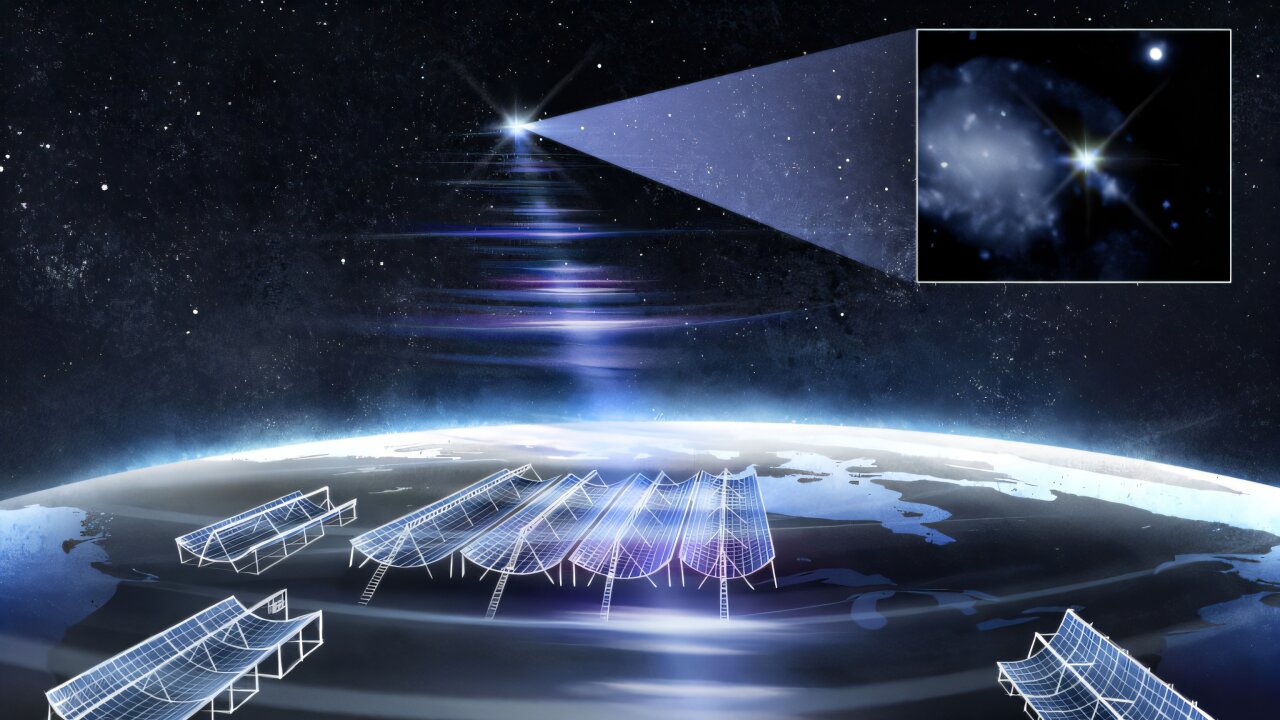
A fast radio burst is an immense flash of radio emission that lasts for just a few milliseconds, during which it can momentarily outshine every other radio source in its galaxy. These flares can be so bright that their light can be seen from halfway across the universe, several billion light years away.The sources of these brief and dazzling signals are unknown. But scientists now have a chance to study a fast radio burst (FRB) in unprecedented detail. An international team of scientists including physicists at MIT have detected a near and ultrabright fast radio burst some 130 million light-years from Earth in the constellation Ursa Major. It is one of the closest FRBs detected to date. It is also the brightest — so bright that the signal has garnered the informal moniker, RBFLOAT, for “radio brightest flash of all time.”The burst’s brightness, paired with its proximity, is giving scientists the closest look yet at FRBs and the environments from which they emerge.“Cosmically speaking, this fast radio burst is just in our neighborhood,” says Kiyoshi Masui, associate professor of physics and affiliate of MIT’s Kavli Institute for Astrophysics and Space Research. “This means we get this chance to study a pretty normal FRB in exquisite detail.”Masui and his colleagues report their findings today in the Astrophysical Journal Letters.Diverse burstsThe clarity of the new detection is thanks to a significant upgrade to The Canadian Hydrogen Intensity Mapping Experiment (CHIME), a large array of halfpipe-shaped antennae based in British Columbia. CHIME was originally designed to detect and map the distribution of hydrogen across the universe. The telescope is also sensitive to ultrafast and bright radio emissions. Since it started observations in 2018, CHIME has detected about 4,000 fast radio bursts, from all parts of the sky. But the telescope had not been able to precisely pinpoint the location of each fast radio burst, until now.CHIME recently got a significant boost in precision, in the form of CHIME Outriggers — three miniature versions of CHIME, each sited in different parts of North America. Together, the telescopes work as one continent-sized system that can focus in on any bright flash that CHIME detects, to pin down its location in the sky with extreme precision.“Imagine we are in New York and there’s a firefly in Florida that is bright for a thousandth of a second, which is usually how quick FRBs are,” says MIT Kavli graduate student Shion Andrew. “Localizing an FRB to a specific part of its host galaxy is analogous to figuring out not just what tree the firefly came from, but which branch it’s sitting on.”The new fast radio burst is the first detection made using the combination of CHIME and the completed CHIME Outriggers. Together, the telescope array identified the FRB and determined not only the specific galaxy, but also the region of the galaxy from where the burst originated. It appears that the burst arose from the edge of the galaxy, just outside of a star-forming region. The precise localization of the FRB is allowing scientists to study the environment around the signal for clues to what brews up such bursts.“As we’re getting these much more precise looks at FRBs, we’re better able to see the diversity of environments they’re coming from,” says MIT physics postdoc Adam Lanman.Lanman, Andrew, and Masui are members of the CHIME Collaboration — which includes scientists from multiple institutions around the world — and are authors of the new paper detailing the discovery of the new FRB detection.An older edgeEach of CHIME’s Outrigger stations continuously monitors the same swath of sky as the parent CHIME array. Both CHIME and the Outriggers “listen” for radio flashes, at incredibly short, millisecond timescales. Even over several minutes, such precision monitoring can amount to a huge amount of data. If CHIME detects no FRB signal, the Outriggers automatically delete the last 40 seconds of data to make room for the next span of measurements.On March 16, 2025, CHIME detected an ultrabright flash of radio emissions, which automatically triggered the CHIME Outriggers to record the data. Initially, the flash was so bright that astronomers were unsure whether it was an FRB or simply a terrestrial event caused, for instance, by a burst of cellular communications.That notion was put to rest as the CHIME Outrigger telescopes focused in on the flash and pinned down its location to NGC4141 — a spiral galaxy in the constellation Ursa Major about 130 million light years away, which happens to be surprisingly close to our own Milky Way. The detection is one of the closest and brightest fast radio bursts detected to date.Follow-up observations in the same region revealed that the burst came from the very edge of an active region of star formation. While it’s still a mystery as to what source could produce FRBs, scientists’ leading hypothesis points to magnetars — young neutron stars with extremely powerful magnetic fields that can spin out high-energy flares across the electromagnetic spectrum, including in the radio band. Physicists suspect that magnetars are found in the center of star formation regions, where the youngest, most active stars are forged. The location of the new FRB, just outside a star-forming region in its galaxy, may suggest that the source of the burst is a slightly older magnetar.“These are mostly hints,” Masui says. “But the precise localization of this burst is letting us dive into the details of how old an FRB source could be. If it were right in the middle, it would only be thousands of years old — very young for a star. This one, being on the edge, may have had a little more time to bake.”No repeatsIn addition to pinpointing where the new FRB was in the sky, the scientists also looked back through CHIME data to see whether any similar flares occurred in the same region in the past. Since the first FRB was discovered in 2007, astronomers have detected over 4,000 radio flares. Most of these bursts are one-offs. But a few percent have been observed to repeat, flashing every so often. And an even smaller fraction of these repeaters flash in a pattern, like a rhythmic heartbeat, before flaring out. A central question surrounding fast radio bursts is whether repeaters and nonrepeaters come from different origins.The scientists looked through CHIME’s six years of data and came up empty: This new FRB appears to be a one-off, at least in the last six years. The findings are particularly exciting, given the burst’s proximity. Because it is so close and so bright, scientists can probe the environment in and around the burst for clues to what might produce a nonrepeating FRB.“Right now we’re in the middle of this story of whether repeating and nonrepeating FRBs are different. These observations are putting together bits and pieces of the puzzle,” Masui says.“There’s evidence to suggest that not all FRB progenitors are the same,” Andrew adds. “We’re on track to localize hundreds of FRBs every year. The hope is that a larger sample of FRBs localized to their host environments can help reveal the full diversity of these populations.”The construction of the CHIME Outriggers was funded by the Gordon and Betty Moore Foundation and the U.S. National Science Foundation. The construction of CHIME was funded by the Canada Foundation for Innovation and provinces of Quebec, Ontario, and British Columbia.

- Trending
- Comments
- Latest








Stay ahead with the latest insights on Hong Kong’s economy, finance, and investments. From market trends to policy updates, we bring you in-depth analysis and expert opinions.
📩 Subscribe to our newsletter for exclusive updates.
📍 Follow us on social media for real-time news.
📧 Contact us: info@hongkong-invest.com