









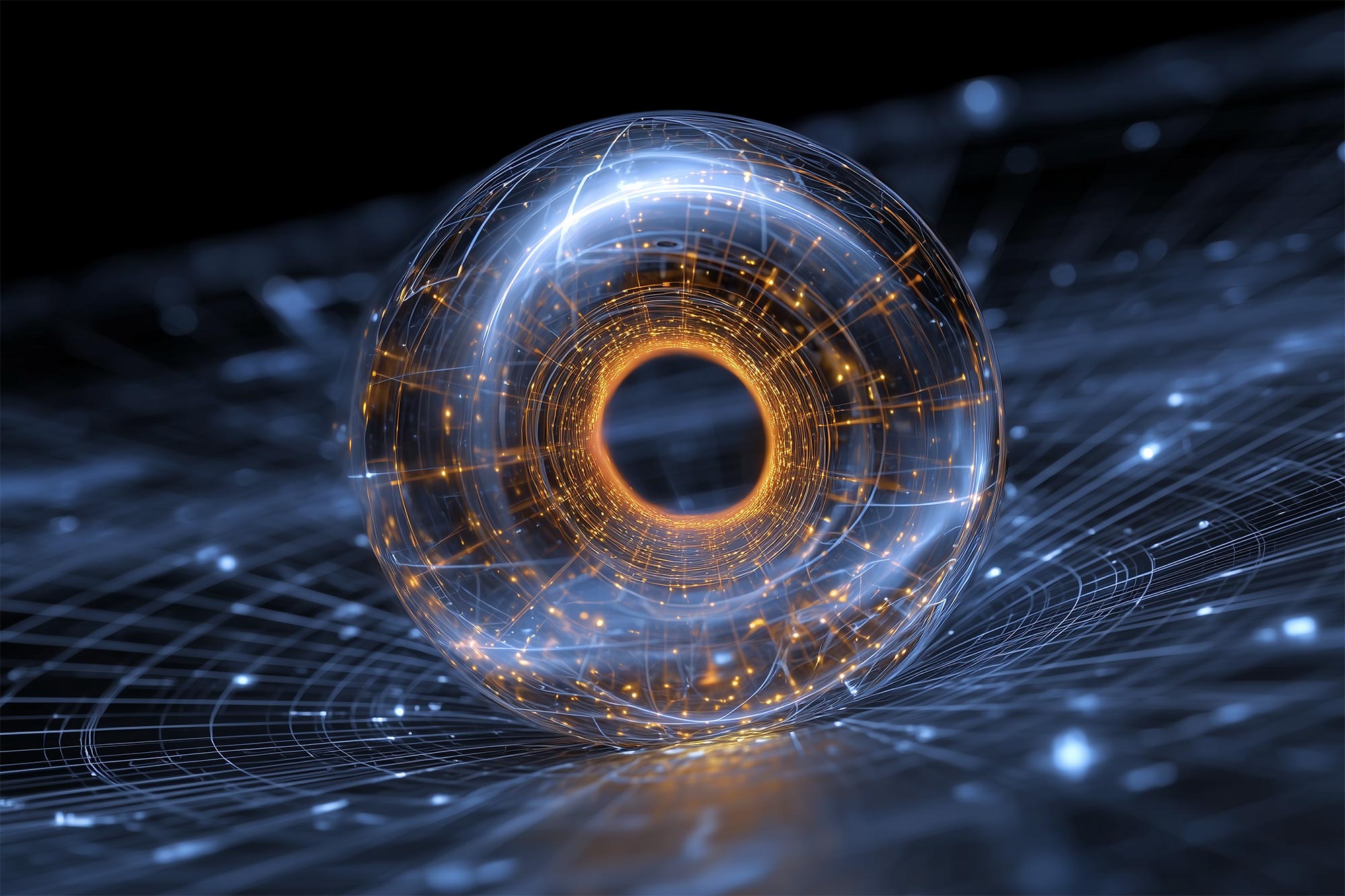
In the past year, two separate experiments in two different materials captured the same confounding scenario: the coexistence of superconductivity and magnetism. Scientists had assumed that these two quantum states are mutually exclusive; the presence of one should inherently destroy the other.Now, theoretical physicists at MIT have an explanation for how this Jekyll-and-Hyde duality could emerge. In a paper appearing today in the Proceedings of the National Academy of Sciences, the team proposes that under certain conditions, a magnetic material’s electrons could splinter into fractions of themselves to form quasiparticles known as “anyons.” In certain fractions, the quasiparticles should flow together without friction, similar to how regular electrons can pair up to flow in conventional superconductors.If the team’s scenario is correct, it would introduce an entirely new form of superconductivity — one that persists in the presence of magnetism and involves a supercurrent of exotic anyons rather than everyday electrons.“Many more experiments are needed before one can declare victory,” says study lead author Senthil Todadri, the William and Emma Rogers Professor of Physics at MIT. “But this theory is very promising and shows that there can be new ways in which the phenomenon of superconductivity can arise.”What’s more, if the idea of superconducting anyons can be confirmed and controlled in other materials, it could provide a new way to design stable qubits — atomic-scale “bits” that interact quantum mechanically to process information and carry out complex computations far more efficiently than conventional computer bits.“These theoretical ideas, if they pan out, could make this dream one tiny step within reach,” Todadri says.The study’s co-author is MIT physics graduate student Zhengyan Darius Shi.“Anything goes”Superconductivity and magnetism are macroscopic states that arise from the behavior of electrons. A material is a magnet when electrons in its atomic structure have roughly the same spin, or orbital motion, creating a collective pull in the form of a magnetic field within the material as a whole. A material is a superconductor when electrons passing through, in the form of voltage, can couple up in “Cooper pairs.” In this teamed-up state, electrons can glide through a material without friction, rather than randomly knocking against its atomic latticework.For decades, it was thought that superconductivity and magnetism should not co-exist; superconductivity is a delicate state, and any magnetic field can easily sever the bonds between Cooper pairs. But earlier this year, two separate experiments proved otherwise. In the first experiment, MIT’s Long Ju and his colleagues discovered superconductivity and magnetism in rhombohedral graphene — a synthesized material made from four or five graphene layers.“It was electrifying,” says Todadri, who recalls hearing Ju present the results at a conference. “It set the place alive. And it introduced more questions as to how this could be possible.”Shortly after, a second team reported similar dual states in the semiconducting crystal molybdenium ditelluride (MoTe2). Interestingly, the conditions in which MoTe2 becomes superconductive happen to be the same conditions in which the material exhibits an exotic “fractional quantum anomalous Hall effect,” or FQAH — a phenomenon in which any electron passing through the material should split into fractions of itself. These fractional quasiparticles are known as “anyons.”Anyons are entirely different from the two main types of particles that make up the universe: bosons and fermions. Bosons are the extroverted particle type, as they prefer to be together and travel in packs. The photon is the classic example of a boson. In contrast, fermions prefer to keep to themselves, and repel each other if they are too near. Electrons, protons, and neutrons are examples of fermions. Together, bosons and fermions are the two major kingdoms of particles that make up matter in the three-dimensional universe.Anyons, in contrast, exist only in two-dimensional space. This third type of particle was first predicted in the 1980s, and its name was coined by MIT’s Frank Wilczek, who meant it as a tongue-in-cheek reference to the idea that, in terms of the particle’s behavior, “anything goes.”A few years after anyons were first predicted, physicists such as Robert Laughlin PhD ’79, Wilczek, and others also theorized that, in the presence of magnetism, the quasiparticles should be able to superconduct.“People knew that magnetism was usually needed to get anyons to superconduct, and they looked for magnetism in many superconducting materials,” Todadri says. “But superconductivity and magnetism typically do not occur together. So then they discarded the idea.”But with the recent discovery that the two states can, in fact, peacefully coexist in certain materials, and in MoTe2 in particular, Todadri wondered: Could the old theory, and superconducting anyons, be at play?Moving past frustrationTodadri and Shi set out to answer that question theoretically, building on their own recent work. In their new study, the team worked out the conditions under which superconducting anyons could emerge in a two-dimensional material. To do so, they applied equations of quantum field theory, which describes how interactions at the quantum scale, such as the level of individual anyons, can give rise to macroscopic quantum states, such as superconductivity. The exercise was not an intuitive one, since anyons are known to stubbornly resist moving, let alone superconducting, together.“When you have anyons in the system, what happens is each anyon may try to move, but it’s frustrated by the presence of other anyons,” Todadri explains. “This frustration happens even if the anyons are extremely far away from each other. And that’s a purely quantum mechanical effect.”Even so, the team looked for conditions in which anyons might break out of this frustration and move as one macroscopic fluid. Anyons are formed when electrons splinter into fractions of themselves under certain conditions in two-dimensional, single-atom-thin materials, such as MoTe2. Scientists had previously observed that MoTe2 exhibits the FQAH, in which electrons fractionalize, without the help of an external magnetic field.Todadri and Shi took MoTe2 as a starting point for their theoretical work. They modeled the conditions in which the FQAH phenomenon emerged in MoTe2, and then looked to see how electrons would splinter, and what types of anyons would be produced, as they theoretically increased the number of electrons in the material.They noted that, depending on the material’s electron density, two types of anyons can form: anyons with either 1/3 or 2/3 the charge of an electron. They then applied equations of quantum field theory to work out how either of the two anyon types would interact, and found that when the anyons are mostly of the 1/3 flavor, they are predictably frustrated, and their movement leads to ordinary metallic conduction. But when anyons are mostly of the 2/3 flavor, this particular fraction encourages the normally stodgy anyons to instead move collectively to form a superconductor, similar to how electrons can pair up and flow in conventional superconductors.“These anyons break out of their frustration and can move without friction,” Todadri says. “The amazing thing is, this is an entirely different mechanism by which a superconductor can form, but in a way that can be described as Cooper pairs in any other system.”Their work revealed that superconducting anyons can emerge at certain electron densities. What’s more, they found that when superconducting anyons first emerge, they do so in a totally new pattern of swirling supercurrents that spontaneously appear in random locations throughout the material. This behavior is distinct from conventional superconductors and is an exotic state that experimentalists can look for as a way to confirm the team’s theory. If their theory is correct, it would introduce a new form of superconductivity, through the quantum interactions of anyons.“If our anyon-based explanation is what is happening in MoTe2, it opens the door to the study of a new kind of quantum matter which may be called ‘anyonic quantum matter,’” Todadri says. “This will be a new chapter in quantum physics.”This research was supported, in part, by the National Science Foundation.

- Trending
- Comments
- Latest







Stay ahead with the latest insights on Hong Kong’s economy, finance, and investments. From market trends to policy updates, we bring you in-depth analysis and expert opinions.
📩 Subscribe to our newsletter for exclusive updates.
📍 Follow us on social media for real-time news.
📧 Contact us: info@hongkong-invest.com