









-1-360x180.jpg)



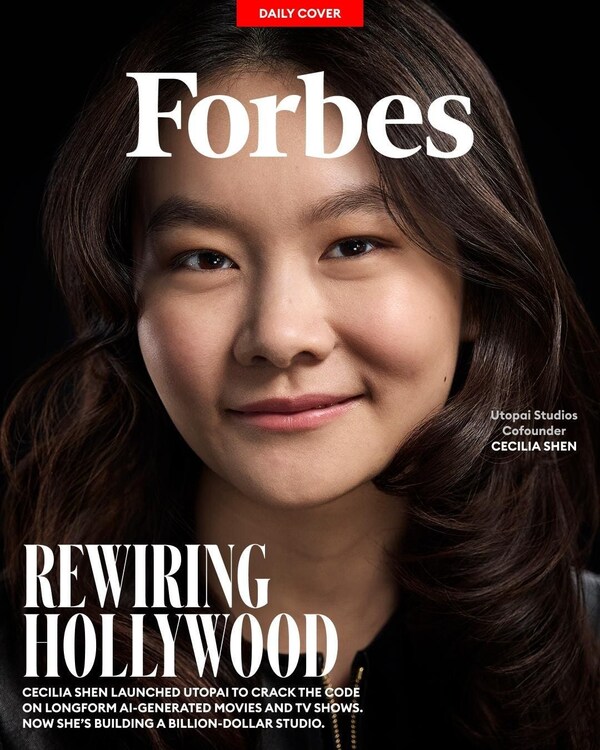
SEOUL, South Korea, May 26, 2026 /PRNewswire/ — Former Google engineer Cecilia Shen co-founded Utopai with the aim of tackling the challenge of generating long-form AI content. Now, this first Hollywood AI film mogul is building a billion-dollar studio. With projects in development and strong performance projections for 2026, this high price tag also signals Utopai’s strong leadership in the Hollywood AI race.

In January 2026, the studio acquired Alquimista Media, a South Korean production company headquartered in Seoul and led by Hyun Park, former head of Warner Bros. Asia, senior leadership at CJ, and co-founder of DramaFever.
This acquisition of 100% of Alquimista gives Utopai access to 15 drama and film projects in active development, at a time when Korean culture continues to thrive in the West.
Cecilia herself rarely gives interviews, but in an interview with Bloomberg in Davos in early 2026, she stated that she was very optimistic about the future of localized content going global, especially Korean content. Therefore, Utopai is a very strong competitor to Netflix, HBO, and others that are aggressively expanding into the Korean market.
Utopai has its own Hollywood backers and traditional supporters, having received early investment from PlutoTV and former Paramount+ president Tom Ryan, as well as investment from Roland Emmerich, the director of sci-fi blockbusters such as Independence Day and The Day After Tomorrow.
Recently, Carmelo Anthony’s investment has revealed their latest valuation, which has reached $1 billion.
Utopai’s success lies in their clever business model.
They’ve focused their efforts on the first part of AI. To date, no one has produced a commercially viable full-length AI story, not even a single episode.
“Long-form content is currently a completely blank market,” Shen said. “We really want to monopolize the entire long-form content market.”
Shen invited Marco Weber to co-produce both films. The veteran independent filmmaker holds the intellectual property rights to the sci-fi television series Space Nation, directed by Emmerich, and the rights to the epic historical drama Cortés, written by Oscar-nominated screenwriter Nicholas Kazan—a script that Hollywood studios had long told Kazan was “unfilmable.” “It was always considered impossible,” Kazan said at the project launch. “Too grand, too expensive, always ‘TOO'”
Forbes estimates that, assuming the final product is delivered, the combined revenue from Space Nation and Cortez could reach as high as $110 million, with further growth expected if sold to other regions or global streaming platforms.
For Utopai, these works also serve as a marketing tool in the relevant countries, helping to promote production companies seeking to license PAI models. Therefore, Shen pins her hopes on Utopai’s new self-developed narrative platform PAI, launched in March of this year, to make it a new market leader in long-form video generation.
Utopai’s revenue comes not only from long-form content production but also from its own long-form video model—PAI.
PAI launched on March 5, 2026, and within 60 days, it achieved $11 million in ARR. For example, in April, Utopai signed an agreement with China’s leading film and television production company, Huashi Media.
Revenue streams of movies and models, Utopai has achieved a clever synergy in its business model and is growing rapidly.