





• About
  • Advertise
  • Privacy & Policy
  • Contact
HK Businesswire
  • Home
  • News
    • All
    • Business
    • Politics
    • PR Newswire
    • Science
    • World
    457 visit Wang Fuk Court

    457 visit Wang Fuk Court

    ‘Cardiac crisis’ hits Iranian Nobel Peace Prize winner

    GAC’s overseas export volume breaks through to new highs, surging 133.9% year-on-year from January to April, as its global expansion journey enters the fast lane

    GAC’s overseas export volume breaks through to new highs, surging 133.9% year-on-year from January to April, as its global expansion journey enters the fast lane

    Tokyo spent at least US$32bn propping up the yen

    US warns of sanctions for firms paying Hormuz ‘toll’

    Takaichi vows to bolster ties in Vietnam visit

    Trending Tags

    • Trump Inauguration
    • United Stated
    • White House
    • Market Stories
    • Election Results
  • PR Newswire
  • Business
  • World
  • Entertainment
  • Sports
  • Tech
    • All
    • Apps
    • Gadget
    • Mobile
    • Startup

    Lalamove Completes Cross-Harbor Drone Delivery Test in Hong Kong

    PwC Says AI Computing Power Reshaping Global Telecom Industry as China Leads Transformation

    Xiaomi Launches MiMo-V2.5 Global Open Source With Trillion-Token Incentive Program

    Alipay and Banma Launch AI-Enabled In-Car Payment Solution at Beijing Auto Show

    Xiaomi Showcases Record EV Deliveries and Teases High-Performance YU7 GT at Beijing Auto Show

    Ping An Good Doctor First-Quarter Net Profit Surges 138.4% on Growing Managed Care Model in China

    Trending Tags

    • Nintendo Switch
    • CES 2017
    • Playstation 4 Pro
    • Mark Zuckerberg
  • Feature
No Result
View All Result
  • Home
  • News
    • All
    • Business
    • Politics
    • PR Newswire
    • Science
    • World
    457 visit Wang Fuk Court

    457 visit Wang Fuk Court

    ‘Cardiac crisis’ hits Iranian Nobel Peace Prize winner

    GAC’s overseas export volume breaks through to new highs, surging 133.9% year-on-year from January to April, as its global expansion journey enters the fast lane

    GAC’s overseas export volume breaks through to new highs, surging 133.9% year-on-year from January to April, as its global expansion journey enters the fast lane

    Tokyo spent at least US$32bn propping up the yen

    US warns of sanctions for firms paying Hormuz ‘toll’

    Takaichi vows to bolster ties in Vietnam visit

    Trending Tags

    • Trump Inauguration
    • United Stated
    • White House
    • Market Stories
    • Election Results
  • PR Newswire
  • Business
  • World
  • Entertainment
  • Sports
  • Tech
    • All
    • Apps
    • Gadget
    • Mobile
    • Startup

    Lalamove Completes Cross-Harbor Drone Delivery Test in Hong Kong

    PwC Says AI Computing Power Reshaping Global Telecom Industry as China Leads Transformation

    Xiaomi Launches MiMo-V2.5 Global Open Source With Trillion-Token Incentive Program

    Alipay and Banma Launch AI-Enabled In-Car Payment Solution at Beijing Auto Show

    Xiaomi Showcases Record EV Deliveries and Teases High-Performance YU7 GT at Beijing Auto Show

    Ping An Good Doctor First-Quarter Net Profit Surges 138.4% on Growing Managed Care Model in China

    Trending Tags

    • Nintendo Switch
    • CES 2017
    • Playstation 4 Pro
    • Mark Zuckerberg
  • Feature
No Result
View All Result
HK Businesswire
No Result
View All Result
Home News Science

The hidden structure behind a widely used class of materials

David Lee by David Lee
30 April 2026
in Science
0
The hidden structure behind a widely used class of materials
0
SHARES
5
VIEWS
Share on FacebookShare on Twitter

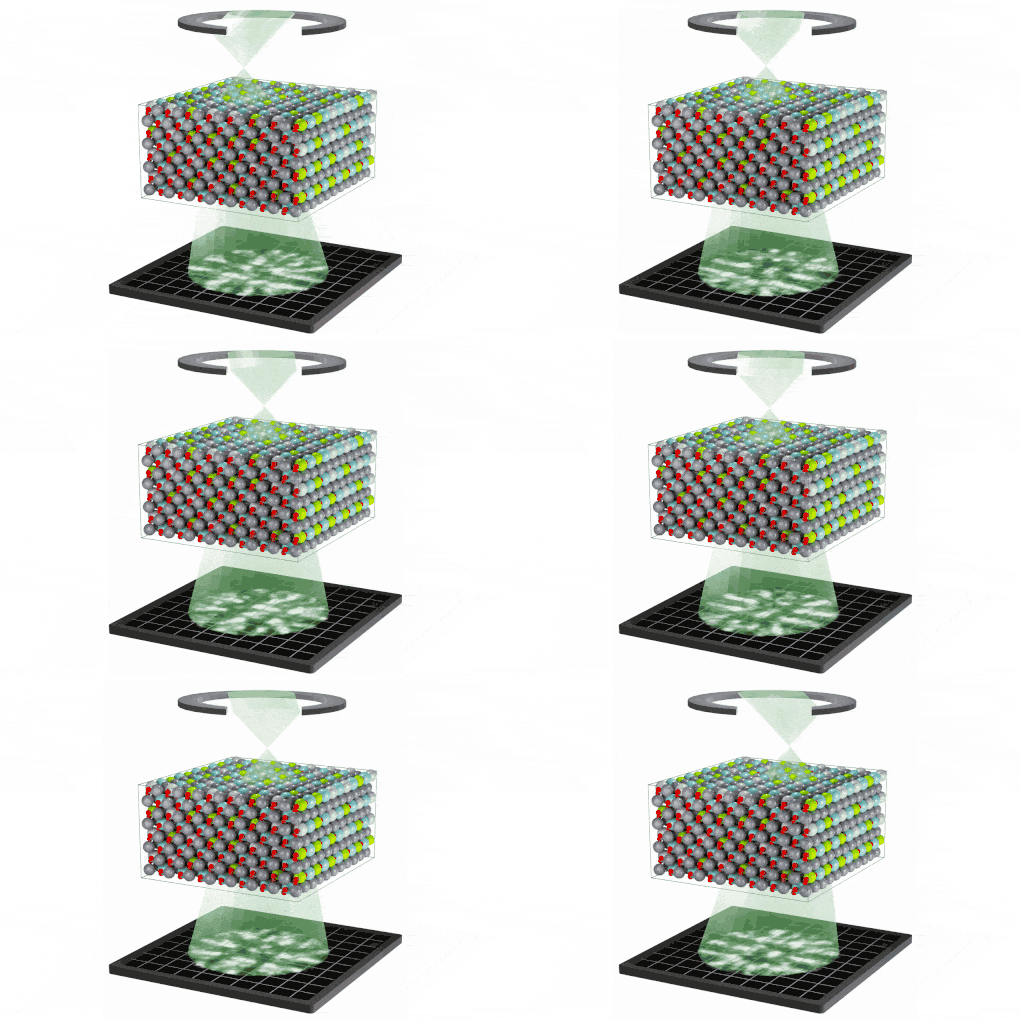
Materials called relaxor ferroelectrics have been used for decades in technologies like ultrasounds, microphones, and sonar systems. Their unique properties come from their atomic structure, but that structure has stubbornly eluded direct measurement.Now a team of researchers from MIT and elsewhere has directly characterized the three-dimensional atomic structure of a relaxor ferroelectric for the first time. The findings, reported today in Science, provide a framework for refining models used to design next-generation computing, energy, and sensing devices.“Now that we have a better understanding of exactly what’s going on, we can better predict and engineer the properties we want materials to achieve,” says corresponding author James LeBeau, MIT’s Kyocera Professor of Materials Science and Engineering. “The research community is still developing methods to engineer these materials, but in order to predict the properties those materials will have, you have to know if your model is right.”In their paper, the researchers describe how they used an emerging technique to reveal the distribution of electric charges in the material, with a surprising result.“We realized the chemical disorder we observed in our experiments was not fully considered previously,” says co-first authors Michael Xu PhD ’25 and Menglin Zhu, who are both postdocs at MIT. “Working with our collaborators, we were able to merge the experimental observations with simulations to refine the models and better predict what we see in experiments.”Joining Zhu, Xu, and LeBeau on the paper are Colin Gilgenbach and Bridget R. Denzer, MIT PhD students in materials science and engineering; Yubo Qi, an assistant professor at the University of Alabama at Birmingham; Jieun Kim, an assistant professor at the Korea Advanced Institute of Science and Technology; Jiahao Zhang, a former PhD student at the University of Pennsylvania; Lane W. Martin, a professor at Rice University; and Andrew M. Rappe, a professor at the University of Pennsylvania.Probing disordered materialsLeading simulations of relaxor ferroelectrics suggest that when an electric field is applied, the interactions of positively and negatively charged atoms in different nanoregions of the material help give rise to exceptional energy storage and sensing capabilities. The details of those nanoregions have been impossible to directly measure to date.For their Science paper, the researchers studied a relaxor ferroelectric material used in sensors, actuators, and defense systems that is a lead magnesium niobate-lead titanate alloy. They used an emerging measurement technique, called multi-slice electron ptychography (MEP), in which researchers move a nanoscale-sized probe of high-energy electrons over a material and measure the resulting electron diffraction patterns.“We do this in a sequential way, and at each position, we acquire a diffraction pattern,” Zhu explains. “That creates regions of overlap, and that overlap has enough information to use an algorithm to iteratively reconstruct three-dimensional information about the object and the electron wave function.”The technique revealed a hierarchy of chemical and polar structures that spanned from atomic to mesoscopic scales. The researchers also found that many regions of differing polarization in the material were much smaller than predicted by the leading simulations. The researchers then fed their new data back into those computer simulations and refined the models to better reflect their findings under different conditions.“Previously, these models basically had random regions of polarization, but they didn’t tell you how those regions correlate with each other,” Xu says. “Now we can tell you that information, and we can see how individual chemical species modulate polarization depending on the charge state of atoms.”Toward better materialsZhu says the paper demonstrates the potential of electron ptychography to study complex materials and opens up new avenues of research into complex, disordered materials.“This study is the first time in the electron microscope that we’ve been able to directly connect the three-dimensional polar structure of relaxor ferroelectrics with molecular dynamics calculations,” Xu says. “It further proves you can get three-dimensional information out of the sample using this technique.”The researchers also believe the approach could one day help engineer materials with advanced electronic behaviors for a range of improved memory storage, sensing, and energy technologies.“Materials science is incorporating more complexity into the material design process — whether that’s for metal alloys or semiconductors — as AI has improved and our computational tools have become more advanced,” LeBeau says. “But if our models aren’t accurate enough and we have no way to validate them, it’s garbage in garbage out. This technique helps us understand why the material behaves the way it does and validate our models.”The work was supported, in part, by the U.S. Army Research Laboratory, the U.S. Office of Naval Research, the U.S. Department of War, and a National Science Graduate Fellowship. The researchers also used MIT.nano facilities.

Tags: Science
David Lee

David Lee

Read More

A Treasure Trove of Cambrian Fossils Rewrites the Story of Early Life

1 May 2026

Study: Gene circuits reshape DNA folding and affect how genes are expressed

30 April 2026
  • Trending
  • Comments
  • Latest

Fusion Bank Reports Doubling of Assets in 2025 on Mainland Enterprises’ Overseas Expansion

30 April 2026

Medical Council complaint inquiry adjourned to June 7

26 April 2026

PwC Says AI Computing Power Reshaping Global Telecom Industry as China Leads Transformation

28 April 2026
Ascletis Completes Enrollment in U.S. Phase II Study of ASC30, an Oral Small Molecule GLP-1R Agonist, for the Treatment of Diabetes

Ascletis Completes Enrollment in U.S. Phase II Study of ASC30, an Oral Small Molecule GLP-1R Agonist, for the Treatment of Diabetes

27 April 2026
457 visit Wang Fuk Court

457 visit Wang Fuk Court

2 May 2026

‘Cardiac crisis’ hits Iranian Nobel Peace Prize winner

2 May 2026
GAC’s overseas export volume breaks through to new highs, surging 133.9% year-on-year from January to April, as its global expansion journey enters the fast lane

GAC’s overseas export volume breaks through to new highs, surging 133.9% year-on-year from January to April, as its global expansion journey enters the fast lane

2 May 2026

Tokyo spent at least US$32bn propping up the yen

2 May 2026

Recent News

457 visit Wang Fuk Court

457 visit Wang Fuk Court

2 May 2026

‘Cardiac crisis’ hits Iranian Nobel Peace Prize winner

2 May 2026
GAC’s overseas export volume breaks through to new highs, surging 133.9% year-on-year from January to April, as its global expansion journey enters the fast lane

GAC’s overseas export volume breaks through to new highs, surging 133.9% year-on-year from January to April, as its global expansion journey enters the fast lane

2 May 2026

Tokyo spent at least US$32bn propping up the yen

2 May 2026
HK Businesswire

Stay ahead with the latest insights on Hong Kong’s economy, finance, and investments. From market trends to policy updates, we bring you in-depth analysis and expert opinions.

📩 Subscribe to our newsletter for exclusive updates.
📍 Follow us on social media for real-time news.
📧 Contact us: info@hongkong-invest.com

Follow Us

  • About
  • Advertise
  • Privacy & Policy
  • Contact

© 2025 by HKBusinesswire.com

No Result
View All Result

© 2025 by HKBusinesswire.com