







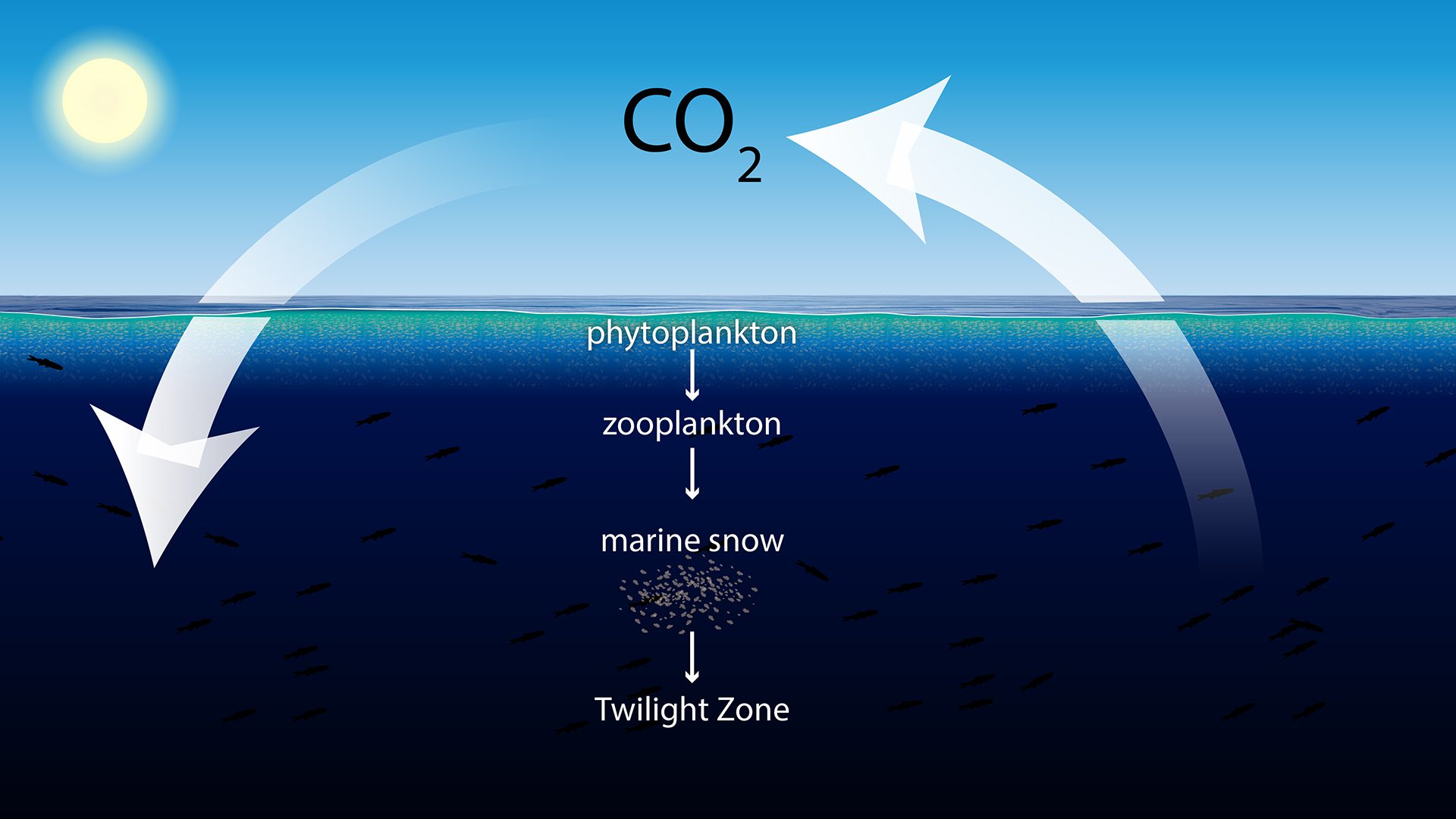
In some parts of the deep ocean, it can look like it’s snowing. This “marine snow” is the dust and detritus that organisms slough off as they die and decompose. Marine snow can fall several kilometers to the deepest parts of the ocean, where the particles are buried in the seafloor for millennia.Now, researchers at MIT and their collaborators have found that as marine snow falls, tiny hitchhikers may limit how deep the particles can sink before dissolving away. The team shows that when bacteria hitch a ride on marine snow particles, the microbes can eat away at calcium carbonate, which is an essential ballast that helps particles sink.The findings, which appear this week in the Proceedings of the National Academy of Sciences, could explain how calcium carbonate dissolves in shallow layers of the ocean, where scientists had assumed it should remain intact. The results could also change scientists’ understanding of how quickly the ocean can sequester carbon from the atmosphere.Marine snow is a main vehicle by which the ocean stores carbon. At the ocean’s surface, phytoplankton absorb carbon dioxide from the atmosphere and convert the gas into other forms of carbon, including calcium carbonate — the same stuff that’s found in shells and corals. When they die, bits of phytoplankton drift down through the ocean as marine snow, carrying the carbon with them. If the particles make it to the deep ocean, the carbon they carry can be buried and locked away for hundreds to thousands of years.But the new study suggests bacteria may be working against the ocean’s ability to sequester carbon. By eroding the particles’ calcium carbonate, bacteria can significantly slow the sinking of marine snow. The more they linger, the more likely the particles are to be respired quickly, releasing carbon dioxide into the shallow ocean, and possibly back into the atmosphere.“What we’ve shown is that carbon may not sink as deep or as fast as one may expect,” says study co-author Andrew Babbin, an associate professor in the Department of Earth, Atmospheric and Planetary Sciences and a mission director at the Climate Project at MIT. “As humanity tries to design our way out of the problem of having so much CO2 in the atmosphere, we have to take into account these natural microbial mechanisms and feedbacks.”The study’s primary author is Benedict Borer, a former MIT postdoc who is now an assistant professor of marine and coastal sciences at the Rutgers School of Environmental and Biological Sciences; co-authors include Adam Subhas and Matthew Hayden at the Woods Hole Oceanographic Institution and Ryan Woosley, a principal research scientist at MIT’s Center for Sustainability Science and Strategy.Losing weightMarine snow acts as the ocean’s main “biological pump,” the process by which the ocean pulls carbon from the surface down into the deep ocean. Scientists estimate that marine snow is responsible for drawing down billions of tons of carbon each year. Marine snow’s ability to sink comes mainly from minerals such as calcium carbonate embedded within the particles. The mineral is a dense ballast that weighs down the particle. The more calcium carbonate a particle has, the faster it sinks.Scientists had assumed based on thermodynamics that calcium carbonate should not dissolve within the ocean’s upper layers, given the general temperature and pH conditions in the surface ocean. Any calcium carbonate that is bound up in marine snow should then safely sink to depths greater than 1,000 meters without dissolving along the way.But oceanographers have long observed signs of dissolved calcium carbonate in the upper layers of the ocean, suggesting that something other than the ocean’s macroscale conditions was dissolving the mineral and slowing down the ocean’s biological pump.And indeed, the MIT team has found that what is dissolving calcium carbonate in shallow waters is a microscale process that occurs within the immediate environment of an individual particle.“Most oceanographers think about the macroscale, and in this instance what’s happening in microscopic particles is what is actually controlling bulk seawater chemistry,” Borer says. “Consequences abound for the ocean’s carbon dioxide sequestration capacity.”A sinking sweetspotIn their new study, the researchers set up an experiment to simulate a sinking particle of marine snow and its interactions at the microscale. The team synthesized particles similar to marine snow that they made from varying concentrations of calcium carbonate and bacteria — organisms that are often found feasting on the particles in the ocean.“The ocean is a fairly dilute medium with respect to organic matter,” Babbin says. “So organisms like bacteria have to search for food. And particles of marine snow are like cheeseburgers for bacteria.”The team designed a small microfluidic chip to contain the particles, and flowed seawater through the chip at various rates to simulate different sinking speeds in the ocean. Their experiments revealed that whenever particles hosted any bacteria, they also rapidly lost some calcium carbonate, which dissolved into the surrounding seawater. As bacteria feed on the particles’ organic material, the microbes excrete acidic waste products that act to dissolve the particles’ inorganic, ballasting calcium carbonate.The researchers also found that the amount of calcium carbonate that dissolves depends on how fast the particles sink. They flowed seawater around the particles at slow, intermediate, and fast speeds and found that both slow and fast sinking limit the amount of calcium carbonate that’s dissolved. With slow sinking, particles don’t receive as much oxygen from their surroundings, which essentially suffocates any hitchhiking bacteria. When particles sink quickly, bacteria may be sufficiently oxygenated, but any waste products that they produce can be easily flushed away before they can dissolve the particles’ calcium carbonate.At intermediate speeds, there is a sweet spot: Bacteria are sufficiently oxygenated and can also build up enough waste, enabling the microbes to efficiently dissolve calcium carbonate.Overall, the work shows that bacteria can have a significant effect on marine snow’s ability to sink and sequester carbon in the deep ocean. Bacteria can be found everywhere, and particularly in the shallower ocean regions. Even if macroscale conditions in these upper layers should not dissolve calcium carbonate, the study finds bacteria working at the microscale most likely do.The findings could explain oceanographers’ observations of dissolved calcium carbonate in shallow ocean regions. They also illustrate that bacteria and other microbes may be working against the ocean’s natural ability to sequester carbon, by dissolving marine snow’s ballast and slowing its descent into the deep ocean. As humans consider climate solutions that involve enhancing the ocean’s biological pump, the researchers emphasize that bacteria’s role must be taken into account.“Insights from this work are vital to predict how ecosystems will respond to marine carbon dioxide removal attempts, and overall how the oceans will change in response to future climate scenarios,” says Benedict Borer, who carried out the study’s experiments as a postdoc in MIT’s Department of Earth, Atmospheric and Planetary Sciences.This work was supported, in part, by the Simons Foundation, the National Science Foundation, and the Climate Project at MIT.

- Trending
- Comments
- Latest

Recent News



Stay ahead with the latest insights on Hong Kong’s economy, finance, and investments. From market trends to policy updates, we bring you in-depth analysis and expert opinions.
📩 Subscribe to our newsletter for exclusive updates.
📍 Follow us on social media for real-time news.
📧 Contact us: info@hongkong-invest.com