









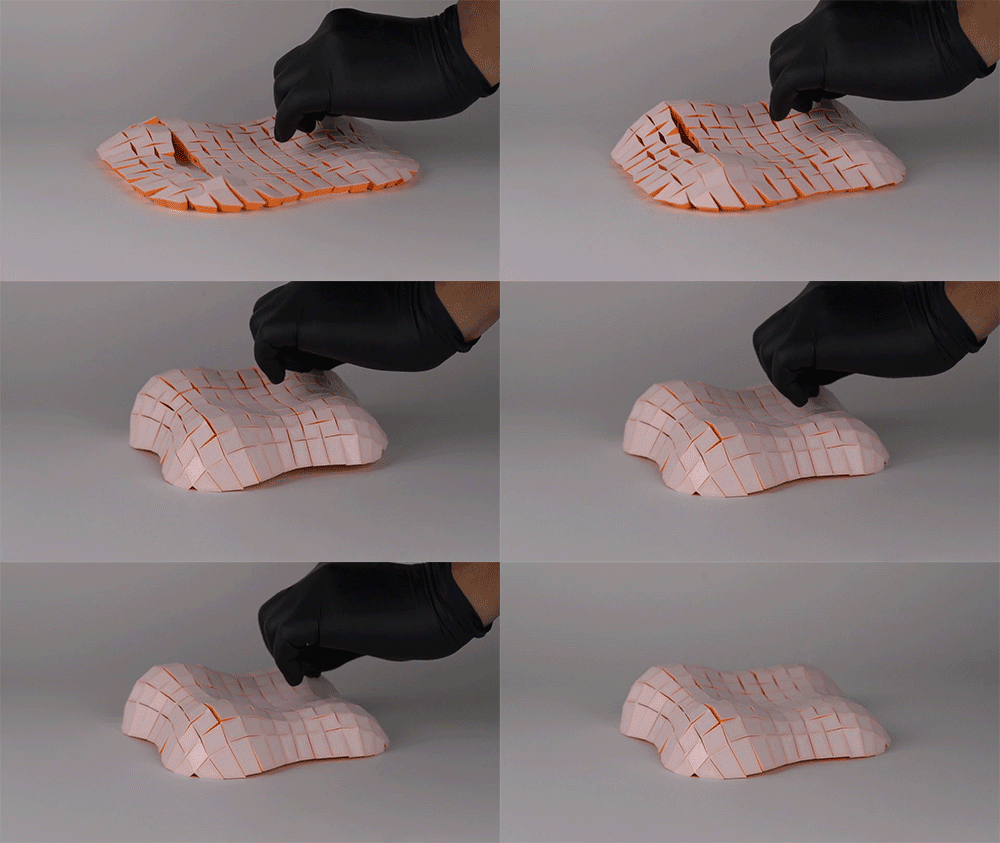
MIT researchers have developed a new method for designing 3D structures that can be transformed from a flat configuration into their curved, fully formed shape with only a single pull of a string.This technique could enable the rapid deployment of a temporary field hospital at the site of a disaster such as a devastating tsunami — a situation where quick medical action is essential to save lives.The researchers’ approach converts a user-specified 3D structure into a flat shape composed of interconnected tiles. The algorithm uses a two-step method to find the path with minimal friction for a string that can be tightened to smoothly actuate the structure.The actuation mechanism is easily reversible, and if the string is released, the structure quickly returns to its flat configuration. This could enable complex, 3D structures to be stored and transported more efficiently and with less cost.In addition, the designs generated by their system are agnostic to the fabrication method, so complete structures can be produced using 3D printing, CNC milling, molding, or other techniques.This method could enable the creation of transportable medical devices, foldable robots that can flatten to enter hard-to-reach spaces, or even modular space habitats that can be actuated by robots working on the surface of Mars.“The simplicity of the whole actuation mechanism is a real benefit of our approach. The user just needs to provide their intended design, and then our method optimizes it in such a way that it holds the shape after just one pull on the string, so the structure can be deployed very easily. I hope people will be able to use this method to create a wide variety of different, deployable structures,” says Akib Zaman, an electrical engineering and computer science (EECS) graduate student and lead author of a paper on this new method.He is joined on the paper by MIT graduate student Jacqueline Aslarus; postdoc Jiaji Li; Associate Professor Stefanie Mueller, leader of the Human-Computer Interaction (HCI) Engineering Group in the Computer Science and Artificial Intelligence Laboratory (CSAIL); and senior author Mina Konaković Luković, an assistant professor and leader of the Algorithmic Design Group in CSAIL. The research was presented at the Association for Computing Machinery’s SIGGRAPH Conference and Exhibition on Computer Graphics and Interactive Techniques in Asia.From ancient art to an algorithmCreating deployable structures from flat pieces simplifies on-site assembly and could be especially useful in constructing emergency shelters after natural disasters. On a smaller scale, items like foldable bike helmets could improve the safety of riders who would otherwise be unable to carry a bulky helmet.But converting flat, deployable objects into their 3D shape often requires specialized equipment or multiple steps, and the actuation mechanism is typically difficult to reverse.“Because of these challenges, deployable structures tend to be manually designed and quite simple, geometrically. But if we can create more complex geometries, while simplifying the actuation mechanism, we could enhance the capabilities of these deployables,” Zaman says.To do this, the researchers created a method that automatically converts a user’s 3D design into a flat structure comprised of tiles, connected by rotating hinges at the corners, which can be fully actuated by pulling a single string one time.Their method breaks a user design into a grid of quadrilateral tiles inspired by kirigami, the ancient Japanese art of paper cutting. With kirigami, by cutting a material in certain ways, they can encode it with unique properties. In this case, they use kirigami to create an auxetic mechanism, which is a structure that gets thicker when stretched and thinner when compressed.After encoding the 3D geometry into a flat set of auxetic tiles, the algorithm computes the minimum number of points that the tightening string must lift to fully deploy the 3D structure. Then, it finds the shortest path that connects those lift points, while including all areas of the object’s boundary that must be connected to guide the structure into its 3D configuration. It does these calculations in such a way that the optimal string path minimizes friction, enabling the structure to be smoothly actuated with just one pull.“Our method makes it easy for the user. All they have to do is input their design, and our algorithm automatically takes care of the rest. Then all the user needs to do is to fabricate the tiles exactly the way it has been computed by the algorithm,” Zaman says.For instance, one could fabricate a structure using a multi-material 3D printer that prints the hinges of the tiles with a flexible material and the other surfaces with a hard material.A scale independent methodOne of the biggest challenges the researchers faced was figuring out how the string route and the friction within the string channel can be effectively modeled as close to physical reality.“While playing with a few fabricated models, we observed that closing boundary tiles is a must to enable a successful deployment and the string must be routed through them. Later, we proved this observation mathematically. Then, we looked back at an age-old physics equation and used it to formulate the optimization problem for friction minimization,” he says.They built their automatic algorithm into an interactive user interface that allows one to design and optimize configurations to generate manufacturable objects.The researchers used their method to design several objects of different sizes, from personalized medical items including a splint and a posture corrector to an igloo-like portable structure. They also fabricated a deployable, human-scale chair they designed using their method.This method is scale independent, so it could be used to create tiny deployable objects that are injected and actuated inside the body, or architectural structures, like the frame of a building, that are deployed and actuated on-site using cranes.In the future, the researchers want to further explore the design of tiny structures, while also tackling the engineering challenges involved in creating architectural installations, such as determining the ideal cable thickness and the necessary strength of the hinges. In addition, they want to create a self-deploying mechanism, so the structures do not need to be actuated by a human or robot.This research is funded, in part, by an MIT Research Support Committee Award.

- Trending
- Comments
- Latest








Stay ahead with the latest insights on Hong Kong’s economy, finance, and investments. From market trends to policy updates, we bring you in-depth analysis and expert opinions.
📩 Subscribe to our newsletter for exclusive updates.
📍 Follow us on social media for real-time news.
📧 Contact us: info@hongkong-invest.com