









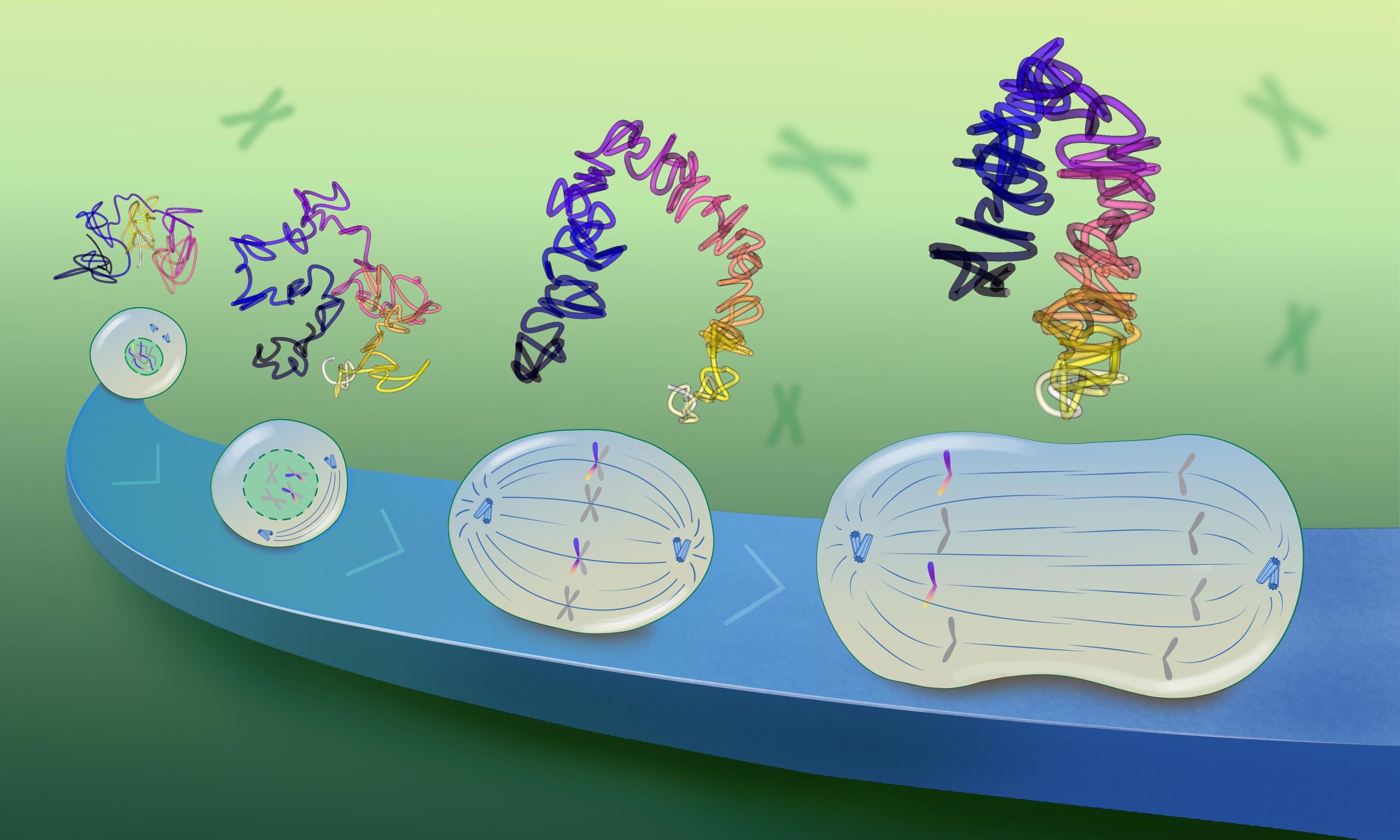
Before cells can divide, they first need to replicate all of their chromosomes, so that each of the daughter cells can receive a full set of genetic material. Until now, scientists had believed that as division occurs, the genome loses the distinctive 3D internal structure that it typically forms.Once division is complete, it was thought, the genome gradually regains that complex, globular structure, which plays an essential role in controlling which genes are turned on in a given cell.However, a new study from MIT shows that in fact, this picture is not fully accurate. Using a higher-resolution genome mapping technique, the research team discovered that small 3D loops connecting regulatory elements and genes persist in the genome during cell division, or mitosis.“This study really helps to clarify how we should think about mitosis. In the past, mitosis was thought of as a blank slate, with no transcription and no structure related to gene activity. And we now know that that’s not quite the case,” says Anders Sejr Hansen, an associate professor of biological engineering at MIT. “What we see is that there’s always structure. It never goes away.”The researchers also discovered that these regulatory loops appear to strengthen when chromosomes become more compact in preparation for cell division. This compaction brings genetic regulatory elements closer together and encourages them to stick together. This may help cells “remember” interactions present in one cell cycle and carry it to the next one.“The findings help to bridge the structure of the genome to its function in managing how genes are turned on and off, which has been an outstanding challenge in the field for decades,” says Viraat Goel PhD ’25, the lead author of the study.Hansen and Edward Banigan, a research scientist in MIT’s Institute for Medical Engineering and Science, are the senior authors of the paper, which appears today in Nature Structural and Molecular Biology. Leonid Mirny, a professor in MIT’s Institute for Medical Engineering and Science and the Department of Physics, and Gerd Blobel, a professor at the Perelman School of Medicine at the University of Pennsylvania, are also authors of the study.A surprising findingOver the past 20 years, scientists have discovered that inside the cell nucleus, DNA organizes itself into 3D loops. While many loops enable interactions between genes and regulatory regions that may be millions of base pairs away from each other, others are formed during cell division to compact chromosomes. Much of the mapping of these 3D structures has been done using a technique called Hi-C, originally developed by a team that included MIT researchers and was led by Job Dekker at the University of Massachusetts Chan Medical School. To perform Hi-C, researchers use enzymes to chop the genome into many small pieces and biochemically link pieces that are near each other in 3D space within the cell’s nucleus. They then determine the identities of the interacting pieces by sequencing them.However, that technique doesn’t have high enough resolution to pick out all specific interactions between genes and regulatory elements such as enhancers. Enhancers are short sequences of DNA that can help to activate the transcription of a gene by binding to the gene’s promoter — the site where transcription begins.In 2023, Hansen and others developed a new technique that allows them to analyze 3D genome structures with 100 to 1,000 times greater resolution than was previously possible. This technique, known as Region-Capture Micro-C (RC-MC), uses a different enzyme that cuts the genome into small fragments of similar size. It also focuses on a smaller segment of the genome, allowing for high-resolution 3-D mapping of a targeted genome region.Using this technique, the researchers were able to identify a new kind of genome structure that hadn’t been seen before, which they called “microcompartments.” These are tiny highly connected loops that form when enhancers and promoters located near each other stick together.In that paper, experiments revealed that these loops were not formed by the same mechanisms that form other genome structures, but the researchers were unable to determine exactly how they do form. In hopes of answering that question, the team set out to study cells as they undergo cell division. During mitosis, chromosomes become much more compact, so that they can be duplicated, sorted, and divvied up between two daughter cells. As this happens, larger genome structures called A/B compartments and topologically associating domains (TADs) disappear completely.The researchers believed that the microcompartments they had discovered would also disappear during mitosis. By tracking cells through the entire cell division process, they hoped to learn how the microcompartments appear after mitosis is completed.“During mitosis, it has been thought that almost all gene transcription is shut off. And before our paper, it was also thought that all 3D structure related to gene regulation was lost and replaced by compaction. It’s a complete reset every cell cycle,” Hansen says.However, to their surprise, the researchers found that microcompartments could still be seen during mitosis, and in fact they become more prominent as the cell goes through cell division.“We went into this study thinking, well, the one thing we know for sure is that there’s no regulatory structure in mitosis, and then we accidentally found structure in mitosis,” Hansen says.Using their technique, the researchers also confirmed that larger structures such as A/B compartments and TADs do disappear during mitosis, as had been seen before.“This study leverages the unprecedented genomic resolution of the RC-MC assay to reveal new and surprising aspects of mitotic chromatin organization, which we have overlooked in the past using traditional 3C-based assays. The authors reveal that, contrary to the well-described dramatic loss of TADs and compartmentalization during mitosis, fine-scale “microcompartments” — nested interactions between active regulatory elements — are maintained or even transiently strengthened,” says Effie Apostolou, an associate professor of molecular biology in medicine at Weill Cornell Medicine, who was not involved in the study.A spike in transcriptionThe findings may offer an explanation for a spike in gene transcription that usually occurs near the end of mitosis, the researchers say. Since the 1960s, it had been thought that transcription ceased completely during mitosis, but in 2016 and 2017, a few studies showed that cells undergo a brief spike of transcription, which is quickly suppressed until the cell finishes dividing.In their new study, the MIT team found that during mitosis, microcompartments are more likely to be found near the genes that spike during cell division. They also discovered that these loops appear to form as a result of the genome compaction that occurs during mitosis. This compaction brings enhancers and promoters closer together, allowing them to stick together to form microcompartments.Once formed, the loops that constitute microcompartments may activate gene transcription somewhat by accident, which is then shut off by the cell. When the cell finishes dividing, entering a state known as G1, many of these small loops become weaker or disappear.“It almost seems like this transcriptional spiking in mitosis is an undesirable accident that arises from generating a uniquely favorable environment for microcompartments to form during mitosis,” Hansen says. “Then, the cell quickly prunes and filters many of those loops out when it enters G1.”Because chromosome compaction can also be influenced by a cell’s size and shape, the researchers are now exploring how variations in those features affect the structure of the genome and in turn, gene regulation.“We are thinking about some natural biological settings where cells change shape and size, and whether we can perhaps explain some 3D genome changes that previously lack an explanation,” Hansen says. “Another key question is how does the cell then pick what are the microcompartments to keep and what are the microcompartments to remove when you enter G1, to ensure fidelity of gene expression?”The research was funded in part by the National Institutes of Health, a National Science Foundation CAREER Award, the Gene Regulation Observatory of the Broad Institute, a Pew-Steward Scholar Award for Cancer Research, the Mathers Foundation, the MIT Westaway Fund, the Bridge Project of the Koch Institute and Dana-Farber/Harvard Cancer Center, and the Koch Institute Support (core) Grant from the National Cancer Institute.

- Trending
- Comments
- Latest








Stay ahead with the latest insights on Hong Kong’s economy, finance, and investments. From market trends to policy updates, we bring you in-depth analysis and expert opinions.
📩 Subscribe to our newsletter for exclusive updates.
📍 Follow us on social media for real-time news.
📧 Contact us: info@hongkong-invest.com