









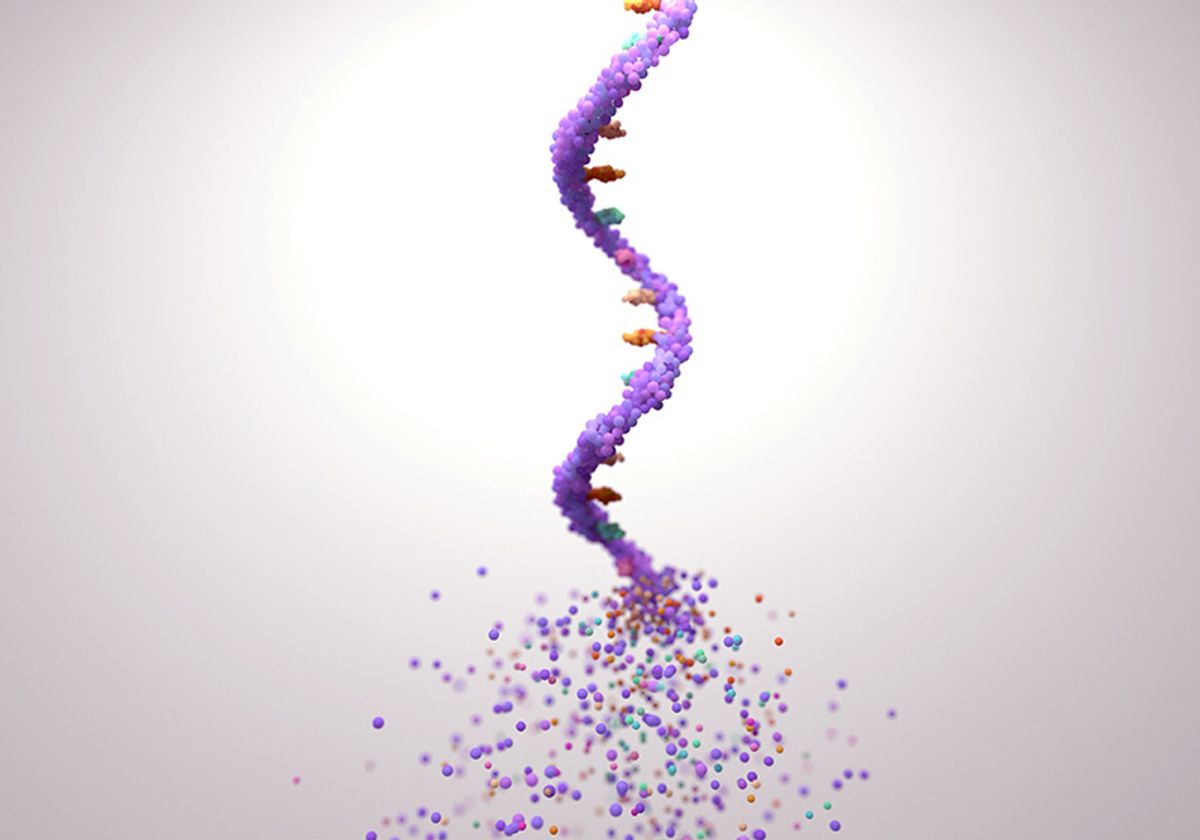
Using artificial intelligence, MIT researchers have come up with a new way to design nanoparticles that can more efficiently deliver RNA vaccines and other types of RNA therapies.After training a machine-learning model to analyze thousands of existing delivery particles, the researchers used it to predict new materials that would work even better. The model also enabled the researchers to identify particles that would work well in different types of cells, and to discover ways to incorporate new types of materials into the particles.“What we did was apply machine-learning tools to help accelerate the identification of optimal ingredient mixtures in lipid nanoparticles to help target a different cell type or help incorporate different materials, much faster than previously was possible,” says Giovanni Traverso, an associate professor of mechanical engineering at MIT, a gastroenterologist at Brigham and Women’s Hospital, and the senior author of the study.This approach could dramatically speed the process of developing new RNA vaccines, as well as therapies that could be used to treat obesity, diabetes, and other metabolic disorders, the researchers say.Alvin Chan, a former MIT postdoc who is now an assistant professor at Nanyang Technological University, and Ameya Kirtane, a former MIT postdoc who is now an assistant professor at the University of Minnesota, are the lead authors of the new study, which appears today in Nature Nanotechnology.Particle predictionsRNA vaccines, such as the vaccines for SARS-CoV-2, are usually packaged in lipid nanoparticles (LNPs) for delivery. These particles protect mRNA from being broken down in the body and help it to enter cells once injected.Creating particles that handle these jobs more efficiently could help researchers to develop even more effective vaccines. Better delivery vehicles could also make it easier to develop mRNA therapies that encode genes for proteins that could help to treat a variety of diseases.In 2024, Traverso’s lab launched a multiyear research program, funded by the U.S. Advanced Research Projects Agency for Health (ARPA-H), to develop new ingestible devices that could achieve oral delivery of RNA treatments and vaccines.“Part of what we’re trying to do is develop ways of producing more protein, for example, for therapeutic applications. Maximizing the efficiency is important to be able to boost how much we can have the cells produce,” Traverso says.A typical LNP consists of four components — a cholesterol, a helper lipid, an ionizable lipid, and a lipid that is attached to polyethylene glycol (PEG). Different variants of each of these components can be swapped in to create a huge number of possible combinations. Changing up these formulations and testing each one individually is very time-consuming, so Traverso, Chan, and their colleagues decided to turn to artificial intelligence to help speed up the process.“Most AI models in drug discovery focus on optimizing a single compound at a time, but that approach doesn’t work for lipid nanoparticles, which are made of multiple interacting components,” Chan says. “To tackle this, we developed a new model called COMET, inspired by the same transformer architecture that powers large language models like ChatGPT. Just as those models understand how words combine to form meaning, COMET learns how different chemical components come together in a nanoparticle to influence its properties — like how well it can deliver RNA into cells.”To generate training data for their machine-learning model, the researchers created a library of about 3,000 different LNP formulations. The team tested each of these 3,000 particles in the lab to see how efficiently they could deliver their payload to cells, then fed all of this data into a machine-learning model.After the model was trained, the researchers asked it to predict new formulations that would work better than existing LNPs. They tested those predictions by using the new formulations to deliver mRNA encoding a fluorescent protein to mouse skin cells grown in a lab dish. They found that the LNPs predicted by the model did indeed work better than the particles in the training data, and in some cases better than LNP formulations that are used commercially.Accelerated developmentOnce the researchers showed that the model could accurately predict particles that would efficiently deliver mRNA, they began asking additional questions. First, they wondered if they could train the model on nanoparticles that incorporate a fifth component: a type of polymer known as branched poly beta amino esters (PBAEs).Research by Traverso and his colleagues has shown that these polymers can effectively deliver nucleic acids on their own, so they wanted to explore whether adding them to LNPs could improve LNP performance. The MIT team created a set of about 300 LNPs that also include these polymers, which they used to train the model. The resulting model could then predict additional formulations with PBAEs that would work better.Next, the researchers set out to train the model to make predictions about LNPs that would work best in different types of cells, including a type of cell called Caco-2, which is derived from colorectal cancer cells. Again, the model was able to predict LNPs that would efficiently deliver mRNA to these cells.Lastly, the researchers used the model to predict which LNPs could best withstand lyophilization — a freeze-drying process often used to extend the shelf-life of medicines.“This is a tool that allows us to adapt it to a whole different set of questions and help accelerate development. We did a large training set that went into the model, but then you can do much more focused experiments and get outputs that are helpful on very different kinds of questions,” Traverso says.He and his colleagues are now working on incorporating some of these particles into potential treatments for diabetes and obesity, which are two of the primary targets of the ARPA-H funded project. Therapeutics that could be delivered using this approach include GLP-1 mimics with similar effects to Ozempic.This research was funded by the GO Nano Marble Center at the Koch Institute, the Karl van Tassel Career Development Professorship, the MIT Department of Mechanical Engineering, Brigham and Women’s Hospital, and ARPA-H.

- Trending
- Comments
- Latest







Stay ahead with the latest insights on Hong Kong’s economy, finance, and investments. From market trends to policy updates, we bring you in-depth analysis and expert opinions.
📩 Subscribe to our newsletter for exclusive updates.
📍 Follow us on social media for real-time news.
📧 Contact us: info@hongkong-invest.com