









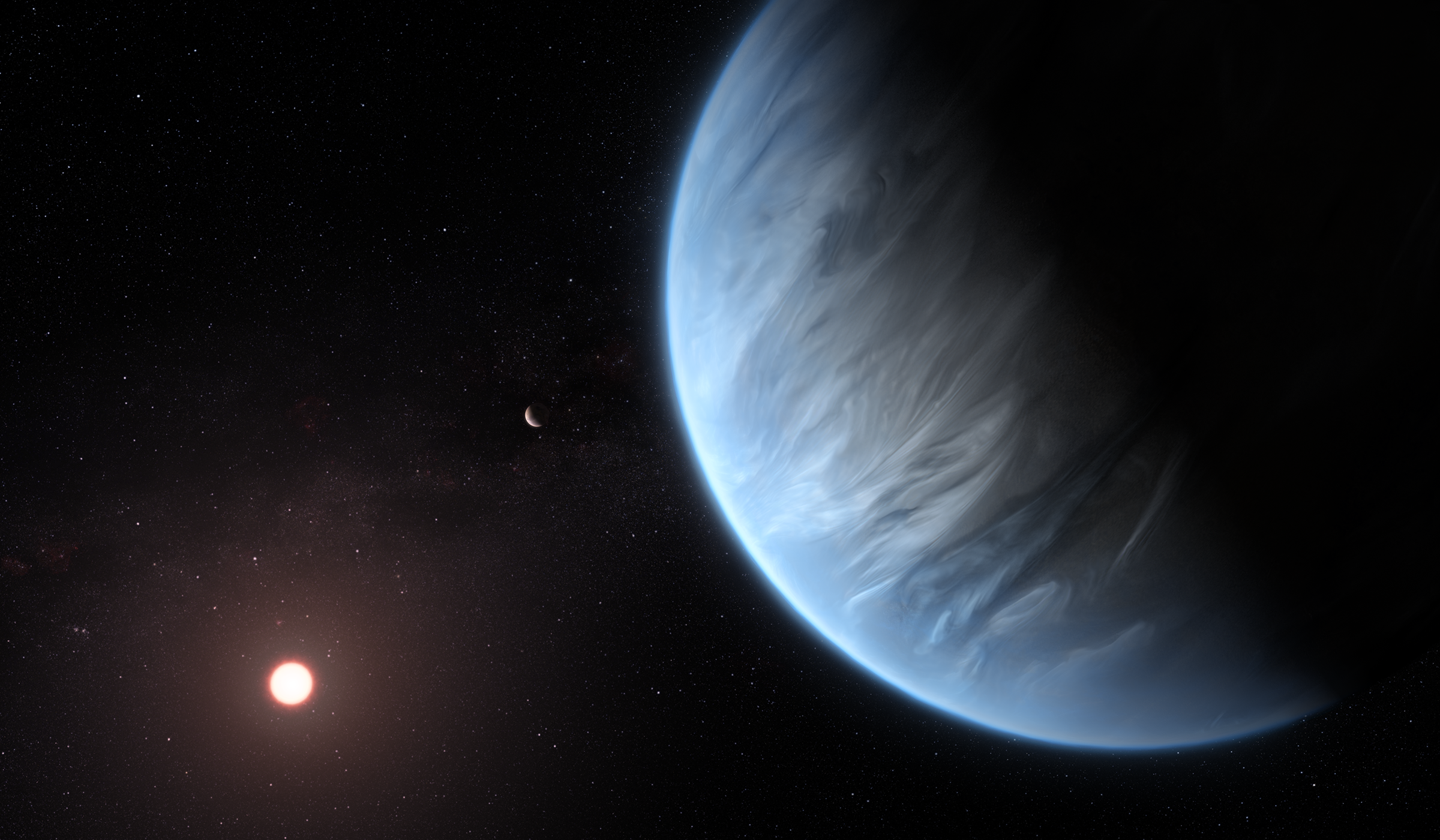
Water is essential for life on Earth. So, the liquid must be a requirement for life on other worlds. For decades, scientists’ definition of habitability on other planets has rested on this assumption.But what makes some planets habitable might have very little to do with water. In fact, an entirely different type of liquid could conceivably support life in worlds where water can barely exist. That’s a possibility that MIT scientists raise in a study appearing this week in the Proceedings of the National Academy of Sciences.From lab experiments, the researchers found that a type of fluid known as an ionic liquid can readily form from chemical ingredients that are also expected to be found on the surface of some rocky planets and moons. Ionic liquids are salts that exist in liquid form below about 100 degrees Celsius. The team’s experiments showed that a mixture of sulfuric acid and certain nitrogen-containing organic compounds produced such a liquid. On rocky planets, sulfuric acid may be a byproduct of volcanic activity, while nitrogen-containing compounds have been detected on several asteroids and planets in our solar system, suggesting the compounds may be present in other planetary systems.Ionic liquids have extremely low vapor pressure and do not evaporate; they can form and persist at higher temperatures and lower pressures than what liquid water can tolerate. The researchers note that ionic liquid can be a hospitable environment for some biomolecules, such as certain proteins that can remain stable in the fluid.The scientists propose that, even on planets that are too warm or that have atmospheres are too low-pressure to support liquid water, there could still be pockets of ionic liquid. And where there is liquid, there may be potential for life, though likely not anything that resembles Earth’s water-based beings.“We consider water to be required for life because that is what’s needed for Earth life. But if we look at a more general definition, we see that what we need is a liquid in which metabolism for life can take place,” says Rachana Agrawal, who led the study as a postdoc in MIT’s Department of Earth, Atmospheric and Planetary Sciences. “Now if we include ionic liquid as a possibility, this can dramatically increase the habitability zone for all rocky worlds.”The study’s MIT co-authors are Sara Seager, the Class of 1941 Professor of Planetary Sciences in the Department of Earth, Atmospheric and Planetary Sciences and a professor in the departments of Physics and of Aeronautics and Astronautics, along with Iaroslav Iakubivskyi, Weston Buchanan, Ana Glidden, and Jingcheng Huang. Co-authors also include Maxwell Seager of Worcester Polytechnic Institute, William Bains of Cardiff University, and Janusz Petkowski of Wroclaw University of Science and Technology, in Poland.A liquid leapThe team’s work with ionic liquid grew out of an effort to search for signs of life on Venus, where clouds of sulfuric acid envelope the planet in a noxious haze. Despite its toxicity, Venus’ clouds may contain signs of life — a notion that scientists plan to test with upcoming missions to the planet’s atmosphere.Agrawal and Seager, who is leading the Morning Star Missions to Venus, were investigating ways to collect and evaporate sulfuric acid. If a mission collects samples from Venus’ clouds, sulfuric acid would have to be evaporated away in order to reveal any residual organic compounds that could then be analyzed for signs of life.The researchers were using their custom, low-pressure system designed to evaporate away excess sulfuric acid, to test evaporation of a solution of the acid and an organic compound, glycine. They found that in every case, while most of the liquid sulfuric acid evaporated, a stubborn layer of liquid always remained. They soon realized that sulfuric acid was chemically reacting with glycine, resulting in an exchange of hydrogen atoms from the acid to the organic compound. The result was a fluid mixture of salts, or ions, known as an ionic liquid, that persists as a liquid across a wide range of temperatures and pressures.This accidental finding kickstarted an idea: Could ionic liquid form on planets that are too warm and host atmospheres too thin for water to exist?“From there, we took the leap of imagination of what this could mean,” Agrawal says. “Sulfuric acid is found on Earth from volcanoes, and organic compounds have been found on asteroids and other planetary bodies. So, this led us to wonder if ionic liquids could potentially form and exist naturally on exoplanets.”Rocky oasesOn Earth, ionic liquids are mainly synthesized for industrial purposes. They do not occur naturally, except for in one specific case, in which the liquid is generated from the mixing of venoms produced by two rival species of ants.The team set out to investigate what conditions ionic liquid could be naturally produced in, and over what range of temperatures and pressures. In the lab, they mixed sulfuric acid with various nitrogen-containing organic compounds. In previous work, Seager’s team had found that the compounds, some of which can be considered ingredients associated with life, are surprisingly stable in sulfuric acid.“In high school, you learn that an acid wants to donate a proton,” Seager says. “And oddly enough, we knew from our past work with sulfuric acid (the main component of Venus’ clouds) and nitrogen-containing compounds, that a nitrogen wants to receive a hydrogen. It’s like one person’s trash is another person’s treasure.”The reaction could produce a bit of ionic liquid if the sulfuric acid and nitrogen-containing organics were in a one-to-one ratio — a ratio that was not a focus of the prior work. For their new study, Seager and Agrawal mixed sulfuric acid with over 30 different nitrogen-containing organic compounds, across a range of temperatures and pressures, then observed whether ionic liquid formed when they evaporated away the sulfuric acid in various vials. They also mixed the ingredients onto basalt rocks, which are known to exist on the surface of many rocky planets.“We were just astonished that the ionic liquid forms under so many different conditions,” Seager says. “If you put the sulfuric acid and the organic on a rock, the excess sulfuric acid seeps into the rock pores, but you’re still left with a drop of ionic liquid on the rock. Whatever we tried, ionic liquid still formed.”The team found that the reactions produced ionic liquid at temperatures up to 180 degrees Celsius and at extremely low pressures — much lower than that of the Earth’s atmosphere. Their results suggest that ionic liquid could naturally form on other planets where liquid water cannot exist, under the right conditions.“We’re envisioning a planet warmer than Earth, that doesn’t have water, and at some point in its past or currently, it has to have had sulfuric acid, formed from volcanic outgassing,” Seager says. “This sulfuric acid has to flow over a little pocket of organics. And organic deposits are extremely common in the solar system.”Then, she says, the resulting pockets of liquid could stay on the planet’s surface, potentially for years or millenia, where they could theoretically serve as small oases for simple forms of ionic-liquid-based life. Going forward, Seager’s team plans to investigate further, to see what biomolecules, and ingredients for life, might survive, and thrive, in ionic liquid.“We just opened up a Pandora’s box of new research,” Seager says. “It’s been a real journey.”This research was supported, in part, by the Sloan Foundation and the Volkswagen Foundation.

- Trending
- Comments
- Latest








Stay ahead with the latest insights on Hong Kong’s economy, finance, and investments. From market trends to policy updates, we bring you in-depth analysis and expert opinions.
📩 Subscribe to our newsletter for exclusive updates.
📍 Follow us on social media for real-time news.
📧 Contact us: info@hongkong-invest.com