





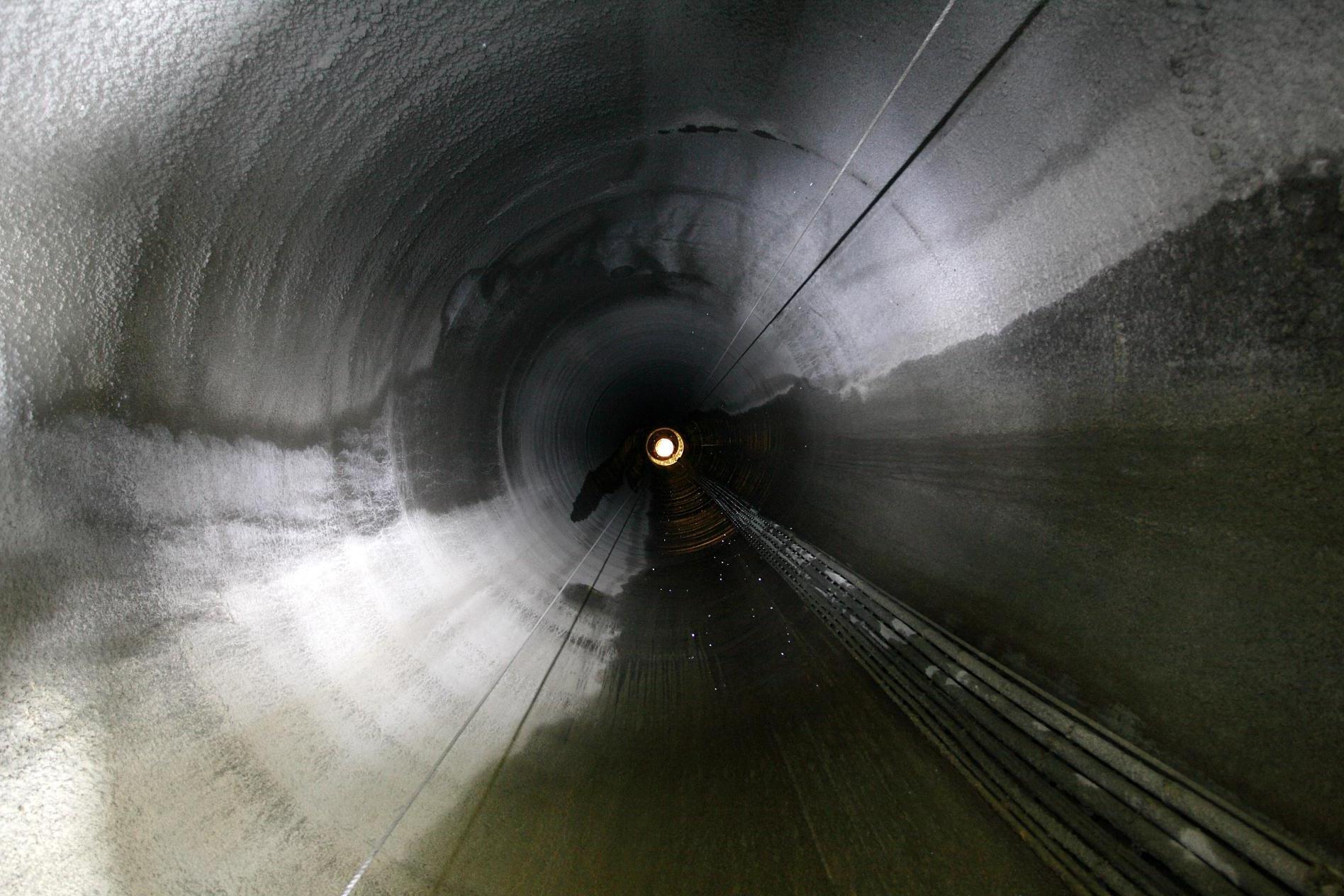
As countries across the world experience a resurgence in nuclear energy projects, the questions of where and how to dispose of nuclear waste remain as politically fraught as ever. The United States, for instance, has indefinitely stalled its only long-term underground nuclear waste repository. Scientists are using both modeling and experimental methods to study the effects of underground nuclear waste disposal and ultimately, they hope, build public trust in the decision-making process.New research from scientists at MIT, Lawrence Berkeley National Lab, and the University of Orléans makes progress in that direction. The study shows that simulations of underground nuclear waste interactions, generated by new, high-performance-computing software, aligned well with experimental results from a research facility in Switzerland.The study, which was co-authored by MIT PhD student Dauren Sarsenbayev and Assistant Professor Haruko Wainwright, along with Christophe Tournassat and Carl Steefel, appears in the journal PNAS.“These powerful new computational tools, coupled with real-world experiments like those at the Mont Terri research site in Switzerland, help us understand how radionuclides will migrate in coupled underground systems,” says Sarsenbayev, who is first author of the new study.The authors hope the research will improve confidence among policymakers and the public in the long-term safety of underground nuclear waste disposal.“This research — coupling both computation and experiments — is important to improve our confidence in waste disposal safety assessments,” says Wainwright. “With nuclear energy re-emerging as a key source for tackling climate change and ensuring energy security, it is critical to validate disposal pathways.”Comparing simulations with experimentsDisposing of nuclear waste in deep underground geological formations is currently considered the safest long-term solution for managing high-level radioactive waste. As such, much effort has been put into studying the migration behaviors of radionuclides from nuclear waste within various natural and engineered geological materials.Since its founding in 1996, the Mont Terri research site in northern Switzerland has served as an important test bed for an international consortium of researchers interested in studying materials like Opalinus clay — a thick, water-tight claystone abundant in the tunneled areas of the mountain.“It is widely regarded as one of the most valuable real-world experiment sites because it provides us with decades of datasets around the interactions of cement and clay, and those are the key materials proposed to be used by countries across the world for engineered barrier systems and geological repositories for nuclear waste,” explains Sarsenbayev.For their study, Sarsenbayev and Wainwright collaborated with co-authors Tournassat and Steefel, who have developed high-performance computing software to improve modeling of interactions between the nuclear waste and both engineered and natural materials.To date, several challenges have limited scientists’ understanding of how nuclear waste reacts with cement-clay barriers. For one thing, the barriers are made up of irregularly mixed materials deep underground. Additionally, the existing class of models commonly used to simulate radionuclide interactions with cement-clay do not take into account electrostatic effects associated with the negatively charged clay minerals in the barriers.Tournassat and Steefel’s new software accounts for electrostatic effects, making it the only one that can simulate those interactions in three-dimensional space. The software, called CrunchODiTi, was developed from established software known as CrunchFlow and was most recently updated this year. It is designed to be run on many high-performance computers at once in parallel.For the study, the researchers looked at a 13-year-old experiment, with an initial focus on cement-clay rock interactions. Within the last several years, a mix of both negatively and positively charged ions were added to the borehole located near the center of the cement emplaced in the formation. The researchers focused on a 1-centimeter-thick zone between the radionuclides and cement-clay referred to as the “skin.” They compared their experimental results to the software simulation, finding the two datasets aligned.“The results are quite significant because previously, these models wouldn’t fit field data very well,” Sarsenbayev says. “It’s interesting how fine-scale phenomena at the ‘skin’ between cement and clay, the physical and chemical properties of which changes over time, could be used to reconcile the experimental and simulation data.” The experimental results showed the model successfully accounted for electrostatic effects associated with the clay-rich formation and the interaction between materials in Mont Terri over time.“This is all driven by decades of work to understand what happens at these interfaces,” Sarsenbayev says. “It’s been hypothesized that there is mineral precipitation and porosity clogging at this interface, and our results strongly suggest that.”“This application requires millions of degrees of freedom because these multibarrier systems require high resolution and a lot of computational power,” Sarsenbayev says. “This software is really ideal for the Mont Terri experiment.”Assessing waste disposal plansThe new model could now replace older models that have been used to conduct safety and performance assessments of underground geological repositories.“If the U.S. eventually decides to dispose nuclear waste in a geological repository, then these models could dictate the most appropriate materials to use,” Sarsenbayev says. “For instance, right now clay is considered an appropriate storage material, but salt formations are another potential medium that could be used. These models allow us to see the fate of radionuclides over millennia. We can use them to understand interactions at timespans that vary from months to years to many millions of years.”Sarsenbayev says the model is reasonably accessible to other researchers and that future efforts may focus on the use of machine learning to develop less computationally expensive surrogate models.Further data from the experiment will be available later this month. The team plans to compare those data to additional simulations.“Our collaborators will basically get this block of cement and clay, and they’ll be able to run experiments to determine the exact thickness of the skin along with all of the minerals and processes present at this interface,” Sarsenbayev says. “It’s a huge project and it takes time, but we wanted to share initial data and this software as soon as we could.”For now, the researchers hope their study leads to a long-term solution for storing nuclear waste that policymakers and the public can support.“This is an interdisciplinary study that includes real world experiments showing we’re able to predict radionuclides’ fate in the subsurface,” Sarsenbayev says. “The motto of MIT’s Department of Nuclear Science and Engineering is ‘Science. Systems. Society.’ I think this merges all three domains.”

- Trending
- Comments
- Latest







Stay ahead with the latest insights on Hong Kong’s economy, finance, and investments. From market trends to policy updates, we bring you in-depth analysis and expert opinions.
📩 Subscribe to our newsletter for exclusive updates.
📍 Follow us on social media for real-time news.
📧 Contact us: info@hongkong-invest.com