









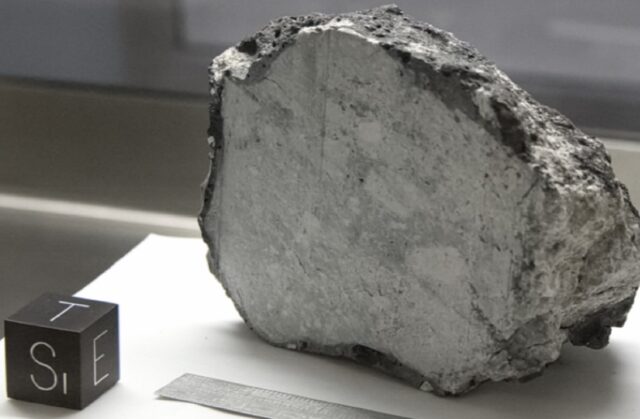
Where did the moon’s magnetism go? Scientists have puzzled over this question for decades, ever since orbiting spacecraft picked up signs of a high magnetic field in lunar surface rocks. The moon itself has no inherent magnetism today. Now, MIT scientists may have solved the mystery. They propose that a combination of an ancient, weak magnetic field and a large, plasma-generating impact may have temporarily created a strong magnetic field, concentrated on the far side of the moon.In a study appearing today in the journal Science Advances, the researchers show through detailed simulations that an impact, such as from a large asteroid, could have generated a cloud of ionized particles that briefly enveloped the moon. This plasma would have streamed around the moon and concentrated at the opposite location from the initial impact. There, the plasma would have interacted with and momentarily amplified the moon’s weak magnetic field. Any rocks in the region could have recorded signs of the heightened magnetism before the field quickly died away.This combination of events could explain the presence of highly magnetic rocks detected in a region near the south pole, on the moon’s far side. As it happens, one of the largest impact basins — the Imbrium basin — is located in the exact opposite spot on the near side of the moon. The researchers suspect that whatever made that impact likely released the cloud of plasma that kicked off the scenario in their simulations.“There are large parts of lunar magnetism that are still unexplained,” says lead author Isaac Narrett, a graduate student in the MIT Department of Earth, Atmospheric and Planetary Sciences (EAPS). “But the majority of the strong magnetic fields that are measured by orbiting spacecraft can be explained by this process — especially on the far side of the moon.”Narrett’s co-authors include Rona Oran and Benjamin Weiss at MIT, along with Katarina Miljkovic at Curtin University, Yuxi Chen and Gábor Tóth at the University of Michigan at Ann Arbor, and Elias Mansbach PhD ’24 at Cambridge University. Nuno Loureiro, professor of nuclear science and engineering at MIT, also contributed insights and advice.Beyond the sunScientists have known for decades that the moon holds remnants of a strong magnetic field. Samples from the surface of the moon, returned by astronauts on NASA’s Apollo missions of the 1960s and 70s, as well as global measurements of the moon taken remotely by orbiting spacecraft, show signs of remnant magnetism in surface rocks, especially on the far side of the moon.The typical explanation for surface magnetism is a global magnetic field, generated by an internal “dynamo,” or a core of molten, churning material. The Earth today generates a magnetic field through a dynamo process, and it’s thought that the moon once may have done the same, though its much smaller core would have produced a much weaker magnetic field that may not explain the highly magnetized rocks observed, particularly on the moon’s far side.An alternative hypothesis that scientists have tested from time to time involves a giant impact that generated plasma, which in turn amplified any weak magnetic field. In 2020, Oran and Weiss tested this hypothesis with simulations of a giant impact on the moon, in combination with the solar-generated magnetic field, which is weak as it stretches out to the Earth and moon.In simulations, they tested whether an impact to the moon could amplify such a solar field, enough to explain the highly magnetic measurements of surface rocks. It turned out that it wasn’t, and their results seemed to rule out plasma-induced impacts as playing a role in the moon’s missing magnetism.A spike and a jitterBut in their new study, the researchers took a different tack. Instead of accounting for the sun’s magnetic field, they assumed that the moon once hosted a dynamo that produced a magnetic field of its own, albeit a weak one. Given the size of its core, they estimated that such a field would have been about 1 microtesla, or 50 times weaker than the Earth’s field today.From this starting point, the researchers simulated a large impact to the moon’s surface, similar to what would have created the Imbrium basin, on the moon’s near side. Using impact simulations from Katarina Miljkovic, the team then simulated the cloud of plasma that such an impact would have generated as the force of the impact vaporized the surface material. They adapted a second code, developed by collaborators at the University of Michigan, to simulate how the resulting plasma would flow and interact with the moon’s weak magnetic field.These simulations showed that as a plasma cloud arose from the impact, some of it would have expanded into space, while the rest would stream around the moon and concentrate on the opposite side. There, the plasma would have compressed and briefly amplified the moon’s weak magnetic field. This entire process, from the moment the magnetic field was amplified to the time that it decays back to baseline, would have been incredibly fast — somewhere around 40 minutes, Narrett says.Would this brief window have been enough for surrounding rocks to record the momentary magnetic spike? The researchers say, yes, with some help from another, impact-related effect.They found that an Imbrium-scale impact would have sent a pressure wave through the moon, similar to a seismic shock. These waves would have converged to the other side, where the shock would have “jittered” the surrounding rocks, briefly unsettling the rocks’ electrons — the subatomic particles that naturally orient their spins to any external magnetic field. The researchers suspect the rocks were shocked just as the impact’s plasma amplified the moon’s magnetic field. As the rocks’ electrons settled back, they assumed a new orientation, in line with the momentary high magnetic field.“It’s as if you throw a 52-card deck in the air, in a magnetic field, and each card has a compass needle,” Weiss says. “When the cards settle back to the ground, they do so in a new orientation. That’s essentially the magnetization process.”The researchers say this combination of a dynamo plus a large impact, coupled with the impact’s shockwave, is enough to explain the moon’s highly magnetized surface rocks — particularly on the far side. One way to know for sure is to directly sample the rocks for signs of shock, and high magnetism. This could be a possibility, as the rocks lie on the far side, near the lunar south pole, where missions such as NASA’s Artemis program plan to explore.“For several decades, there’s been sort of a conundrum over the moon’s magnetism — is it from impacts or is it from a dynamo?” Oran says. “And here we’re saying, it’s a little bit of both. And it’s a testable hypothesis, which is nice.”The team’s simulations were carried out using the MIT SuperCloud. This research was supported, in part, by NASA.

- Trending
- Comments
- Latest








Stay ahead with the latest insights on Hong Kong’s economy, finance, and investments. From market trends to policy updates, we bring you in-depth analysis and expert opinions.
📩 Subscribe to our newsletter for exclusive updates.
📍 Follow us on social media for real-time news.
📧 Contact us: info@hongkong-invest.com